

Industry: Transportation
Product: Tamara
Application: Traffic congestion analysis
One Activity Carries the Reopening Date — Utility Relocation at Cruciality 0.59
A metropolitan transport authority committed to a congestion-relief upgrade of a strangled arterial corridor — road widening, two intersection upgrades and an adaptive-signal system, built in phases so lanes stay open. Scheduled the orthodox way, with most-likely durations rolled through the network, it showed a 600-day, April 2028 reopening. Because every day of works inflicts congestion-delay cost on the travelling public, the date was the project's whole economic case — but the bar chart could not show which of the phased works actually governs it, so attention drifted to the visible signal works rather than what was buried under the road.
Rebuilt in Tamara, Vose Software's Monte Carlo project risk tool, with each activity carrying a Beta-PERT duration and six discrete risks on top, plotting every work by criticality index against cruciality produces the de-risk map — the top-right corner is where to spend first:
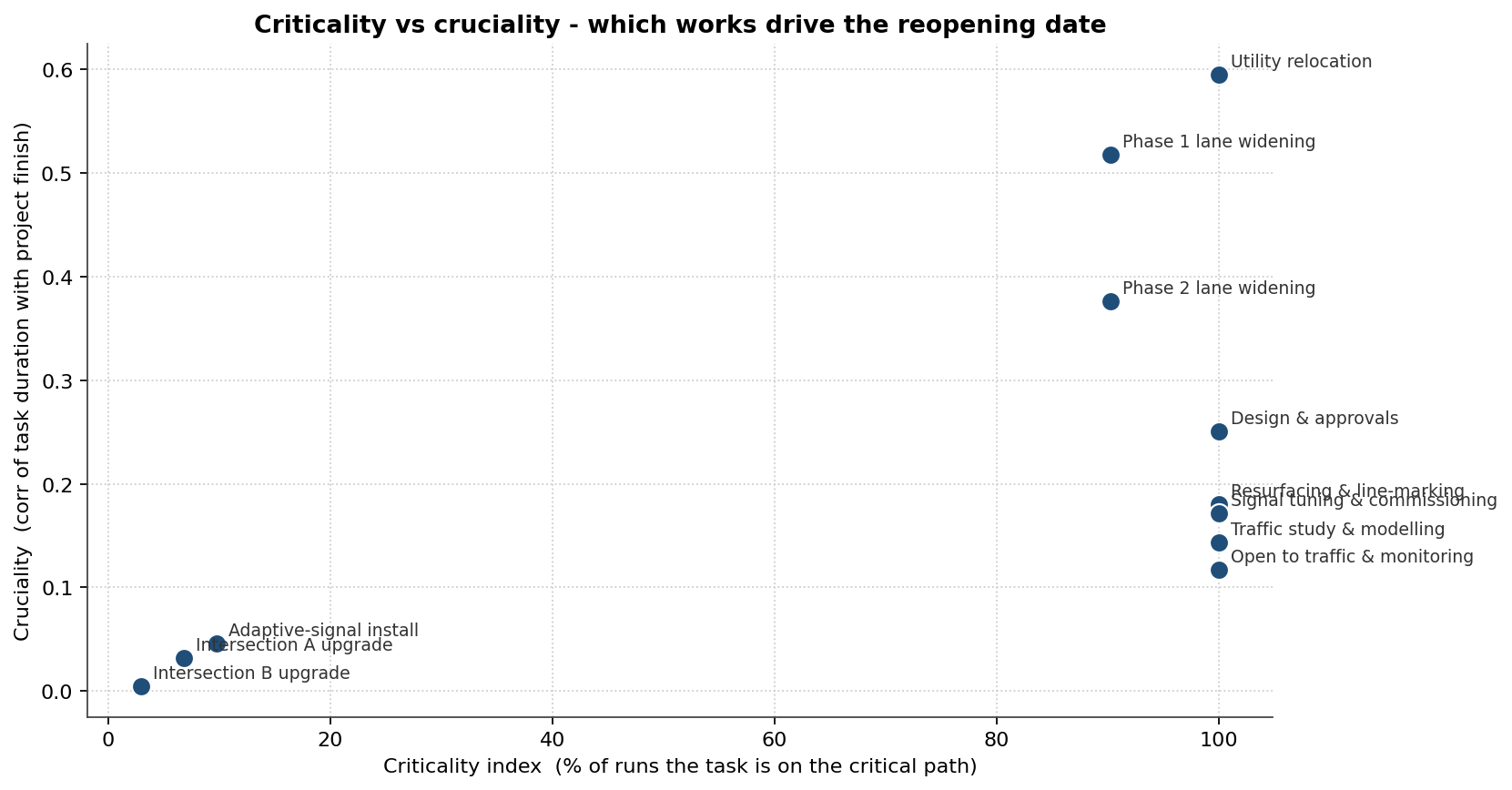
Utility relocation dominates (criticality 100%, cruciality 0.59) — the classic buried-services unknown that sits upstream of every widening phase — followed by Phase 1 lane widening (90%, 0.52) and Phase 2 lane widening (90%, 0.38), with design & approvals (100%, 0.25) and resurfacing & line-marking (100%, 0.18) well behind. The action list is the utilities investigation and the widening phases, not the signal works that draw the public's attention.
How Much Contingency the Schedule Needs
The plan has only a 1% chance of being met, so the real question is how much buffer to hold. Turning the reopening distribution into a ladder gives a fundable number for each confidence level beyond the 600-day plan:
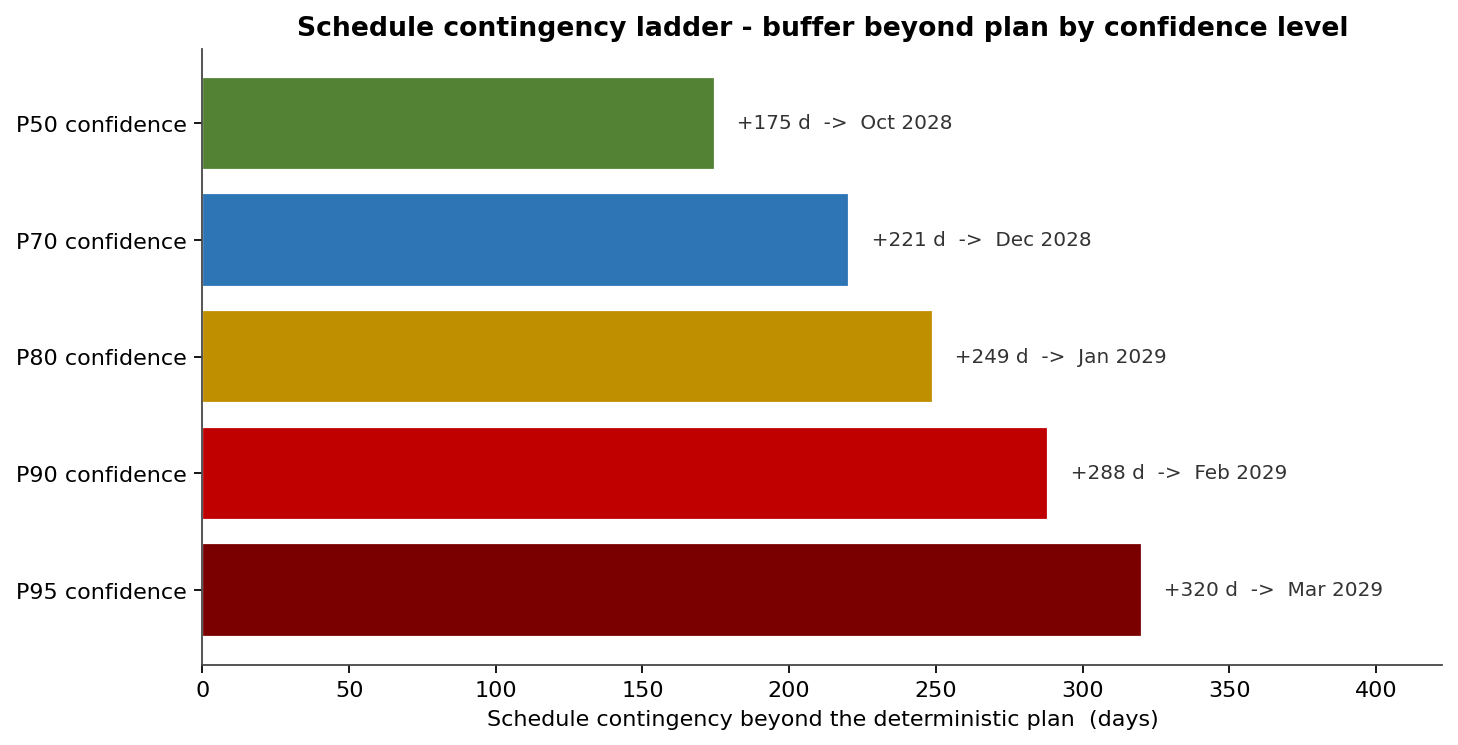
Each rung is days beyond plan to reopening. P50 needs +175 days (reopen 775), P70 +221 (821), P80 +249 (849), P90 +288 (888) and P95 +320 (920). The simulated reopening runs P10 671, P50 775, P90 888, mean 778 against the 600-day plan — so the P80 buffer of 249 days, roughly 8.2 months, is the honest contingency, and every one of those days is congestion the deterministic plan never priced.
Where the Duration Risk Actually Lives
Tamara ranks each activity by cruciality — the rank-correlation between its duration and the reopening date:
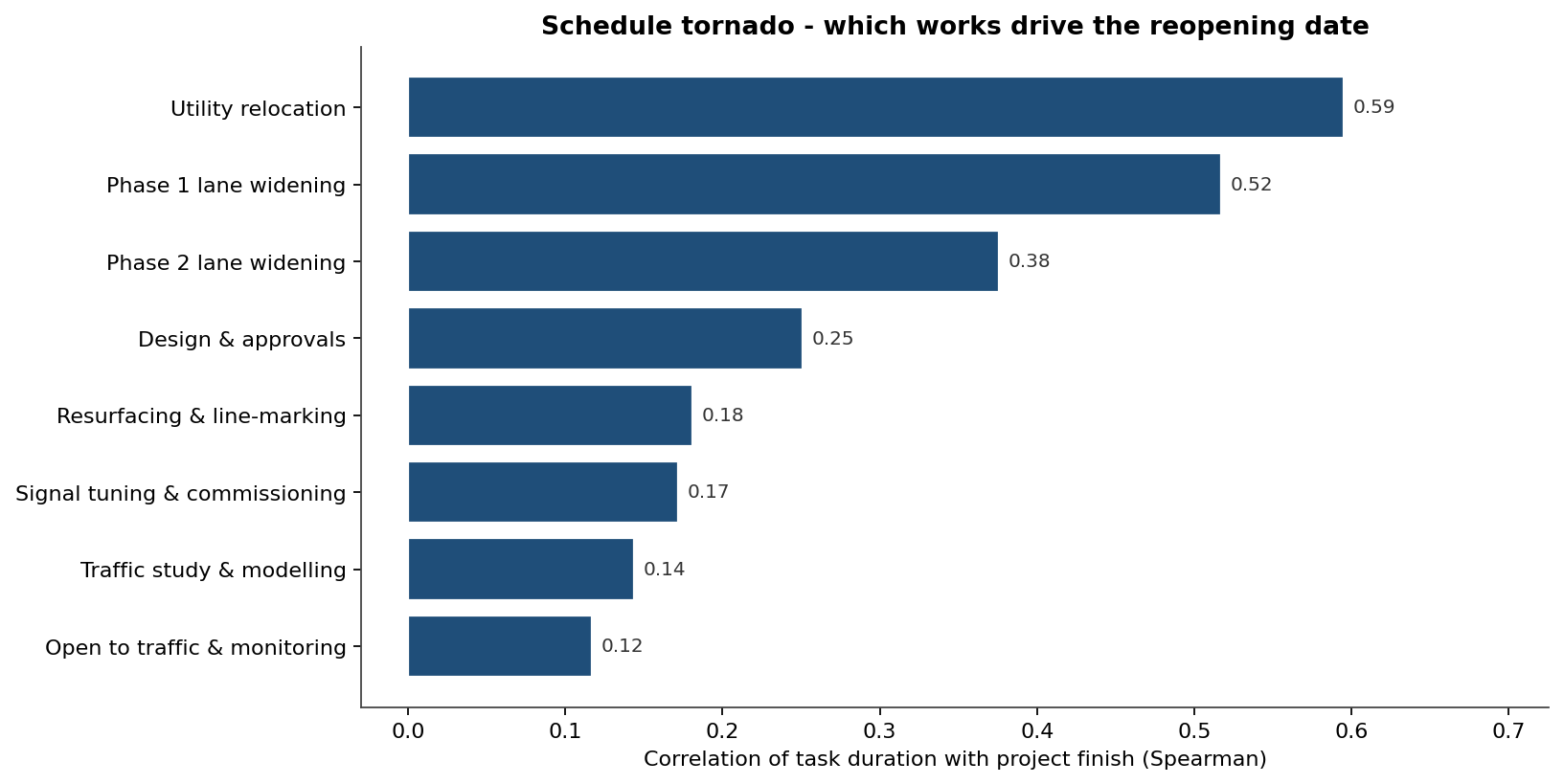
The ranking confirms the scatter from the other direction: utility relocation 0.59, Phase 1 lane widening 0.52, Phase 2 lane widening 0.38. A single buried-services activity carries more of the reopening risk than any built element — so a pre-construction utility survey is the highest-leverage move on the whole project.
Schedule Risk Is Cost Risk
Every day of works inflicts congestion-delay cost on the public — the project's economic justification — so the schedule distribution drives the cost distribution. Tamara let the authority price a mitigation package together — a pre-construction utility survey, an incentivised productivity contract, weather-resilient methods and early signal procurement — and compare before/after on one axis:
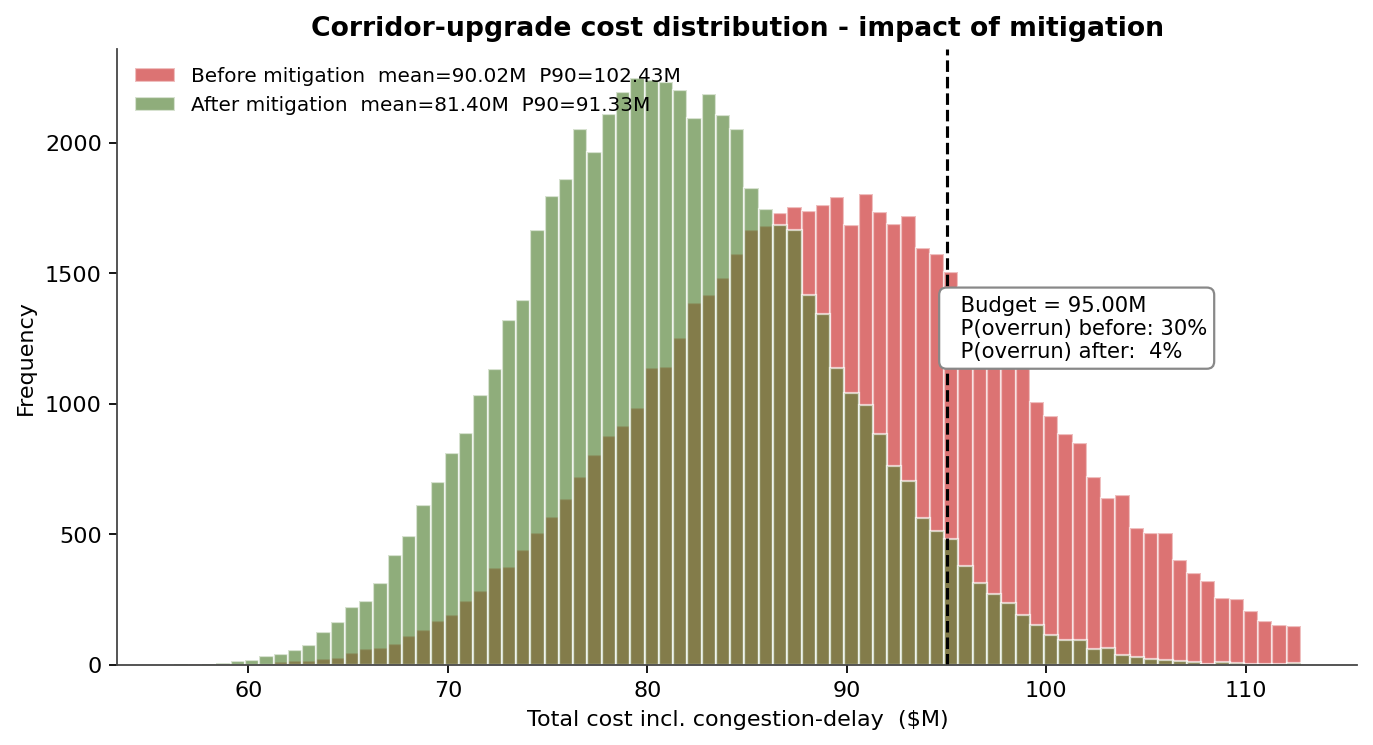
Without mitigation the cost, including congestion-delay, runs to a mean of $90M and a P90 of $102M, with a 30% probability of breaching the $95M budget. The mitigation package cuts the P80 reopening by 82 days (849 → 767 days), and because works duration drives public cost, the overrun probability falls from 30% to 4% and the P90 cost drops to $91M — nearly three months of avoided congestion for the city.
The Discrete Risks That Drive the Tail
Six discrete events were modelled as Bernoulli risks. Ranking them by expected schedule impact (probability × delay) gives a clean Pareto:
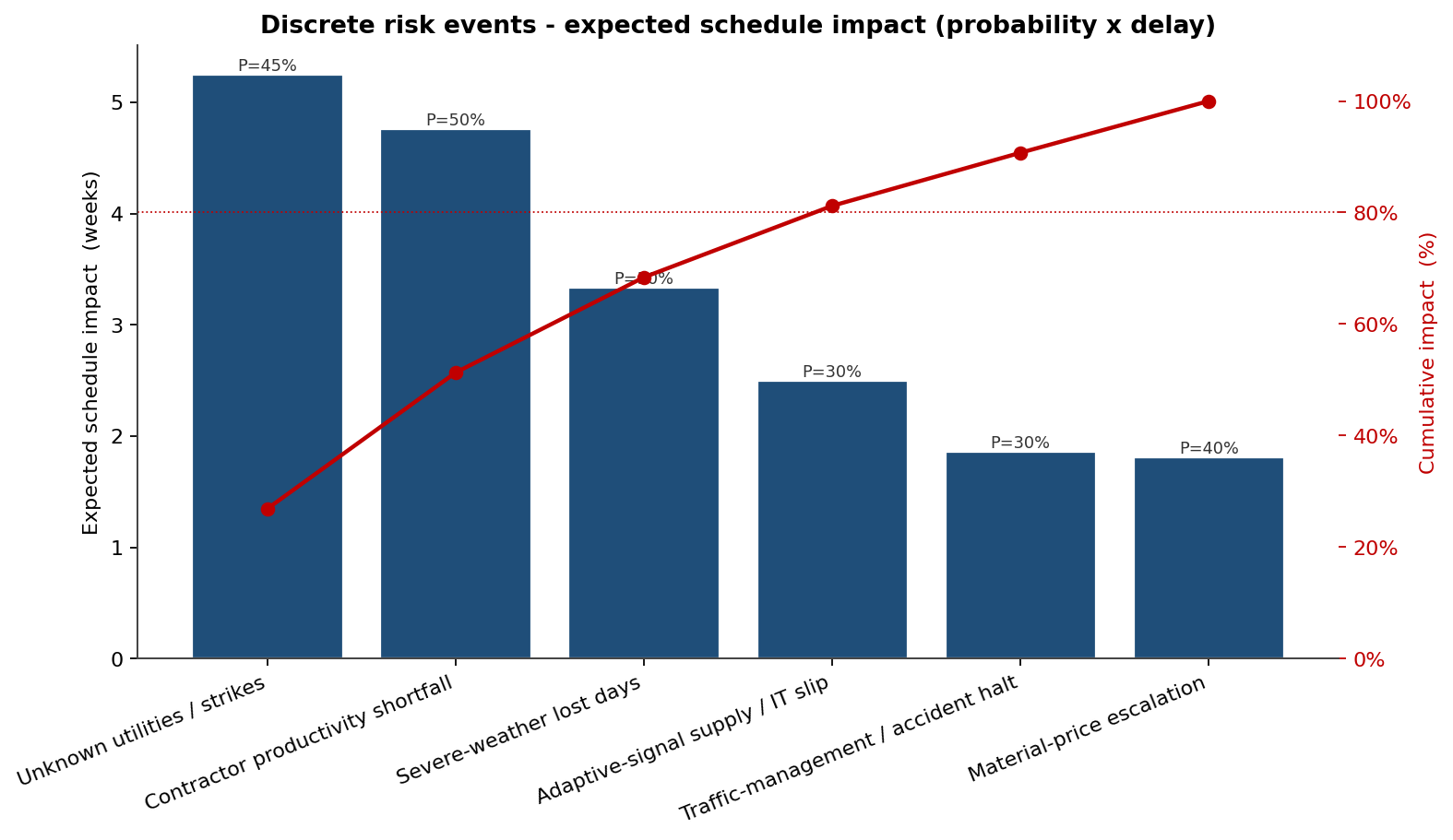
Four of the six events carry ~80% of the expected discrete-event delay — unknown utilities / strikes (5.2 weeks expected), a contractor productivity shortfall (4.8), severe-weather lost days (3.3) and an adaptive-signal supply/IT slip (2.5), with a traffic-management/accident halt (1.9) and material-price escalation (1.8) trailing. The largest strikes utility relocation — the same activity the scatter and tornado both flag — so the pre-construction utility survey is the highest-leverage single buy.
What Tamara Changed
- Risk-reduction effort was directed to utility relocation and the widening phases — the highest-cruciality works (0.59, 0.52, 0.38) — instead of the visible signal works.
- The contingency decision became a confidence choice — the ladder priced every rung from P50 (+175 d) to P95 (+320 d), and the authority funded the P80 buffer of 249 days.
- The reopening commitment moved from the 1%-likely April 2028 date to a risk-informed P80, so the authority could brief the public on a date it could hold.
- A utility-survey and incentive package was approved on its tail-clipping effect, cutting budget-overrun probability from 30% to 4%.
Tamara Functionality Used
- Monte Carlo schedule simulation over the phased corridor network, with Beta-PERT durations and parallel-intersection logic.
- Criticality and cruciality analysis naming utility relocation as the governing driver, mapped on one scatter and ranked on a tornado.
- Contingency-ladder analysis translating the reopening distribution into a buffer-per-confidence schedule the authority can fund.
- Discrete risk-event modelling (Bernoulli occurrence × Triangular impact) for utilities, productivity, weather and supply risks.
- Integrated cost–schedule modelling linking works duration to public congestion-delay cost.
- Scenario comparison quantifying the mitigation package's before/after impact on both the P80 reopening and the overrun probability.
A corridor upgrade is not a reopening date; it is a distribution whose tail the public pays for in lost time. Tamara is what names the one activity to de-risk first — and turns "when does the road reopen?" into a probability the authority can defend.