

Industry: Project Management
Product: Tamara
Application: Stakeholder communication risks
The Plan Promised a May 2029 Finish. The Simulation Gives It a 1% Chance
A $1.2 billion urban-transit project was scheduled around its work — concept, design, environmental assessment, construction, handover — and the deterministic roll-up gave a clean 1,080-day, May 2029 finish. What the bar chart treated as instantaneous were the things that actually stall transit projects: the approval gates between phases, where regulatory sign-off, funding release and community consent each wait on a stakeholder who does not work to the project's calendar. Modelled as discrete stakeholder-gate risks rather than zero-duration milestones, those gates turn the single date into a distribution.
Rebuilt in Tamara, Vose Software's Monte Carlo project risk tool, the deterministic date dissolves into a spread whose cumulative S-curve makes the whole argument — the published plan sits at the very foot of the curve:
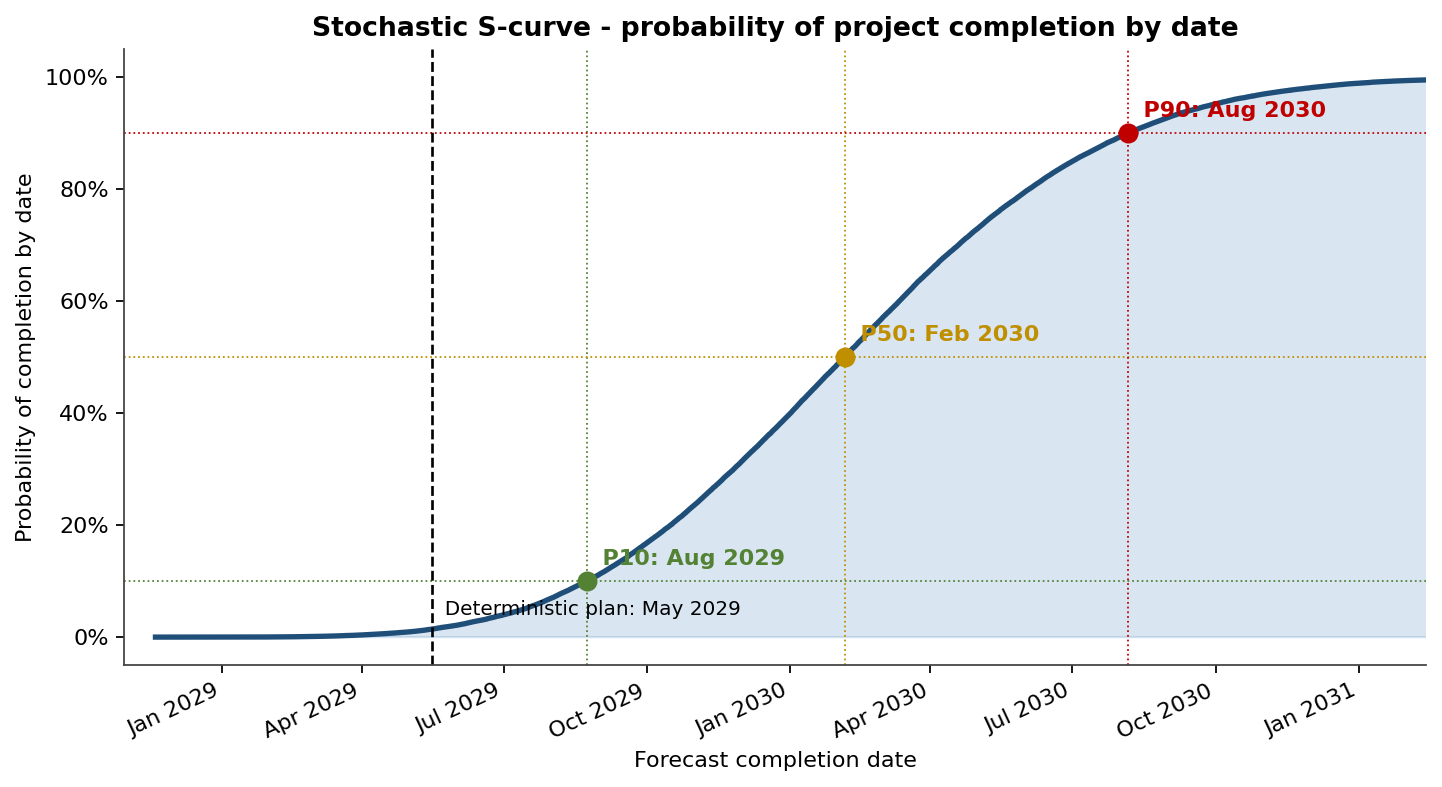
The S-curve reads off as P50 1,345 days (February 2030) and P90 1,527 days (August 2030), against the 1,080-day plan. The probability of finishing by that plan is just 1%, and the gap between it and the P80 finish is 383 days — roughly 12.6 months. That gap is the project's true contingency, and most of it sits in the gate queues, not the construction front.
The Discrete Risks That Drive the Tail
Tamara ranks the six gate risks by expected schedule impact (probability × delay), and the top three are all approval gates, not construction tasks:
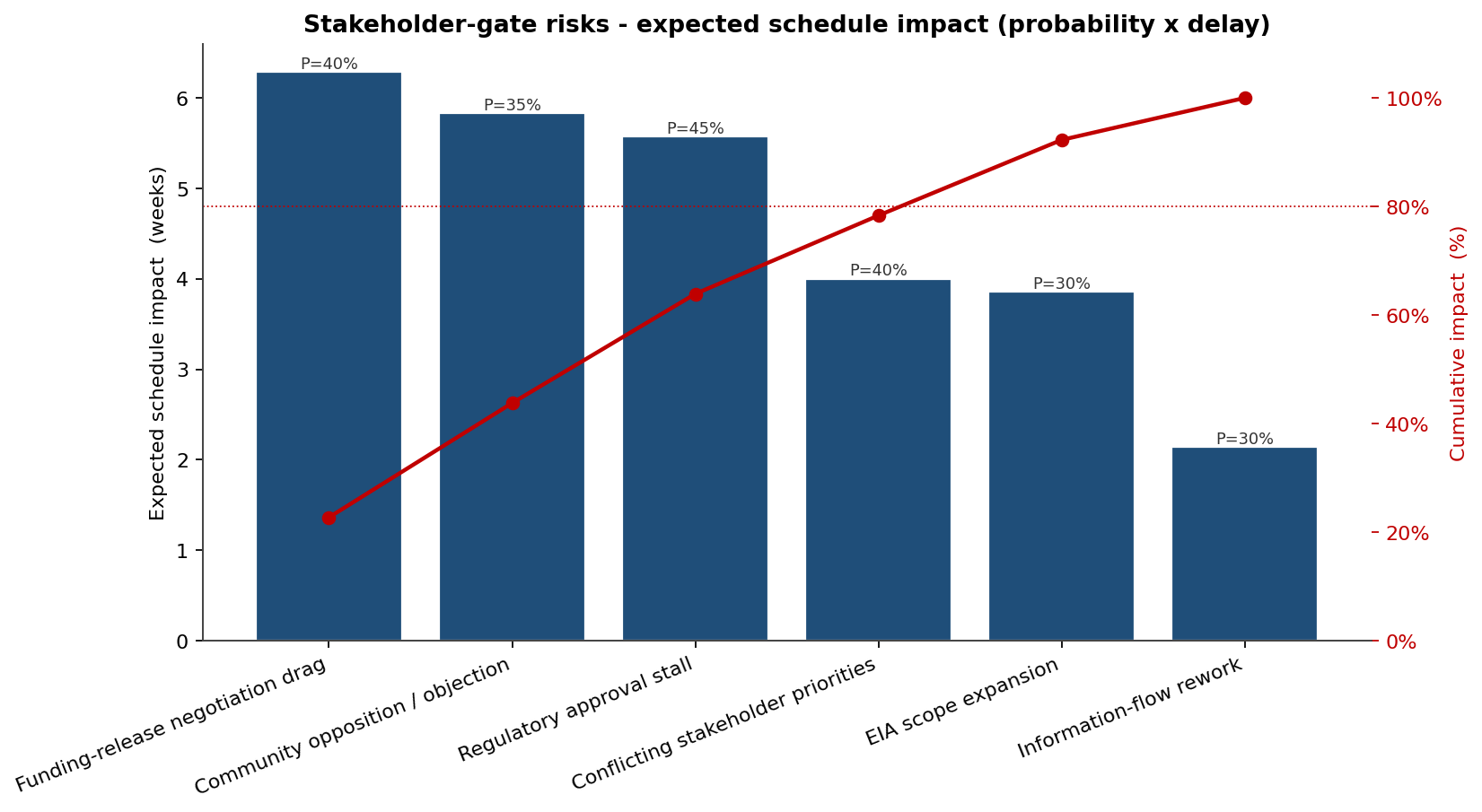
Five of the six gate events carry ~80% of the expected discrete-risk delay — a funding-release negotiation drag (6.3 weeks expected), community opposition (5.8), a regulatory approval stall (5.6), conflicting stakeholder priorities (4.0) and an EIA scope expansion (3.9), with information-flow rework (2.1) trailing. Stakeholder communication is the schedule risk here, and the Pareto says exactly which conversations to resource first.
Where the Risk Actually Lives
Plotting every activity by criticality index against cruciality confirms it from the other direction — and a sign-off gate sits in the top-right de-risk corner alongside the build:
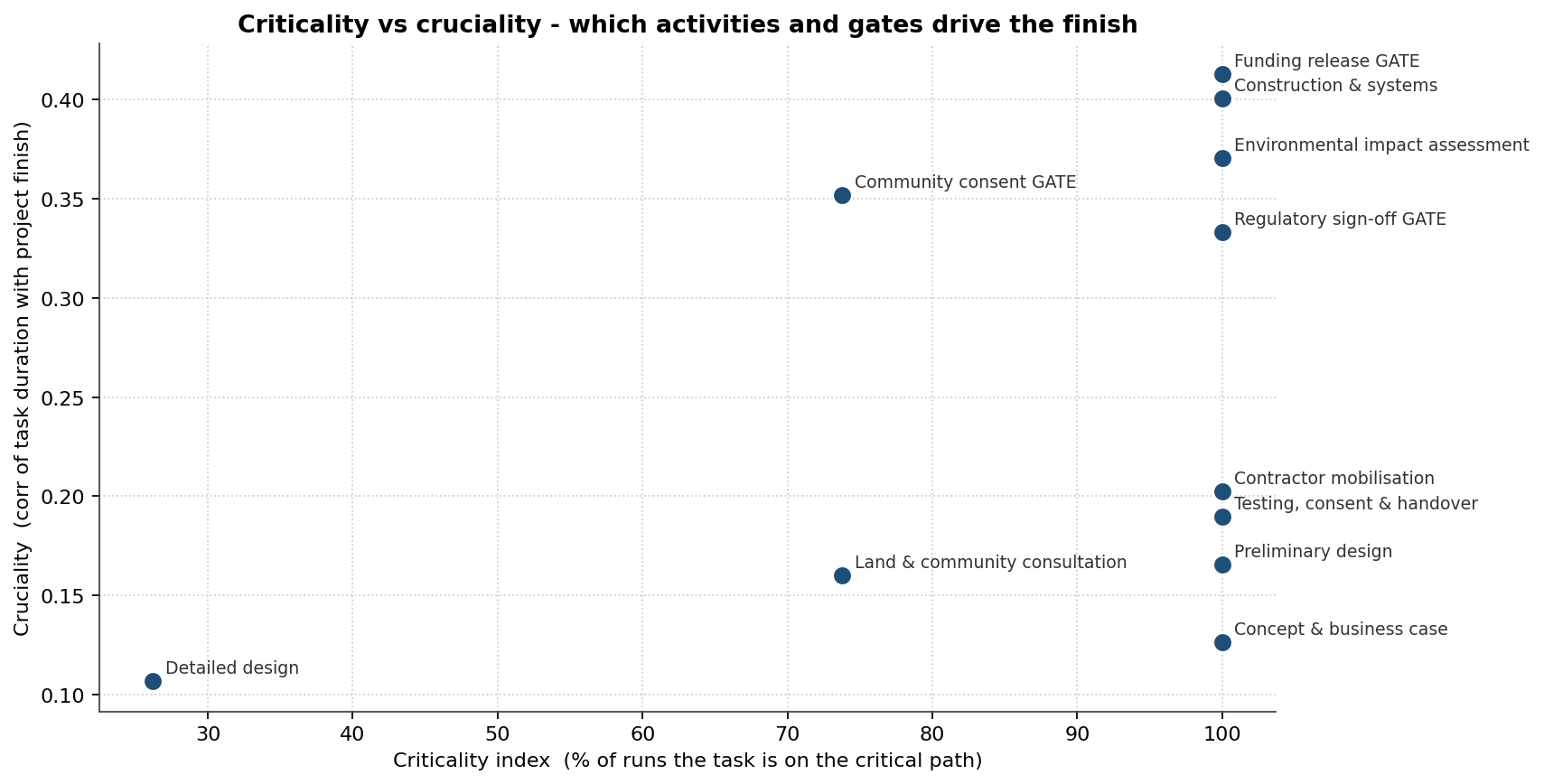
The funding-release gate tops the ranking (criticality 100%, cruciality 0.41), neck-and-neck with construction & systems (100%, 0.40) and ahead of the environmental impact assessment (100%, 0.37), the community-consent gate (74%, 0.35) and the regulatory sign-off gate (100%, 0.33). That a sign-off gate out-ranks the construction package is the headline: on this project the stakeholder clock, not the concrete, governs the finish.
Schedule Risk Is Cost Risk
Every day a gate holds the project open carries financing carry and escalation, so late finishes and budget breaches arrive together. Plotting each iteration as a point on cost-versus-schedule axes shows how tightly the two failures are coupled:
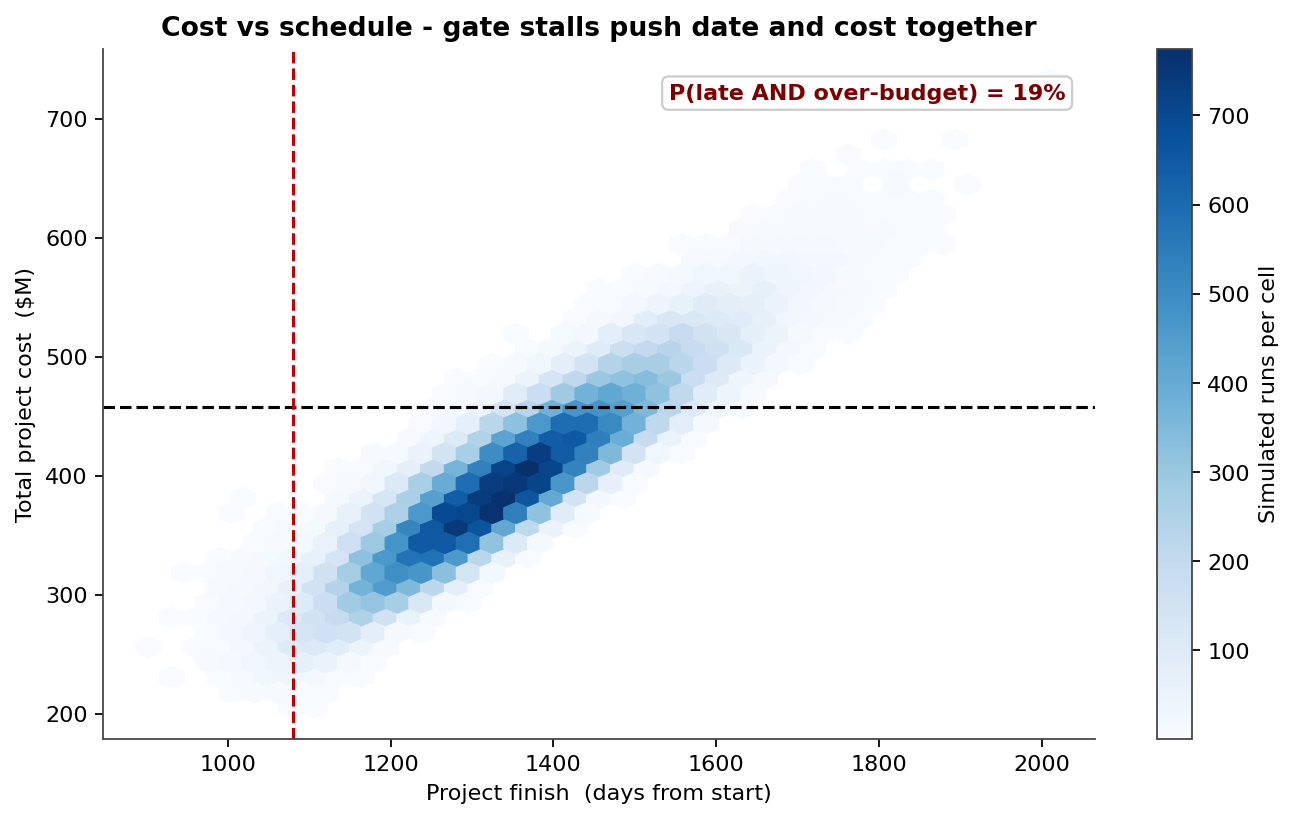
The upper-right quadrant — late and over the $458M budget — holds 19% of all runs: nearly one project in five fails on both axes at once because the same stalled gates that push the date out also rack up the carry. Treating cost and schedule as one risk is the only honest reading.
How Much Contingency the Gates Imply
Turning the finish distribution into a buffer-per-confidence ladder gives the team a fundable number for each rung beyond the 1,080-day plan:
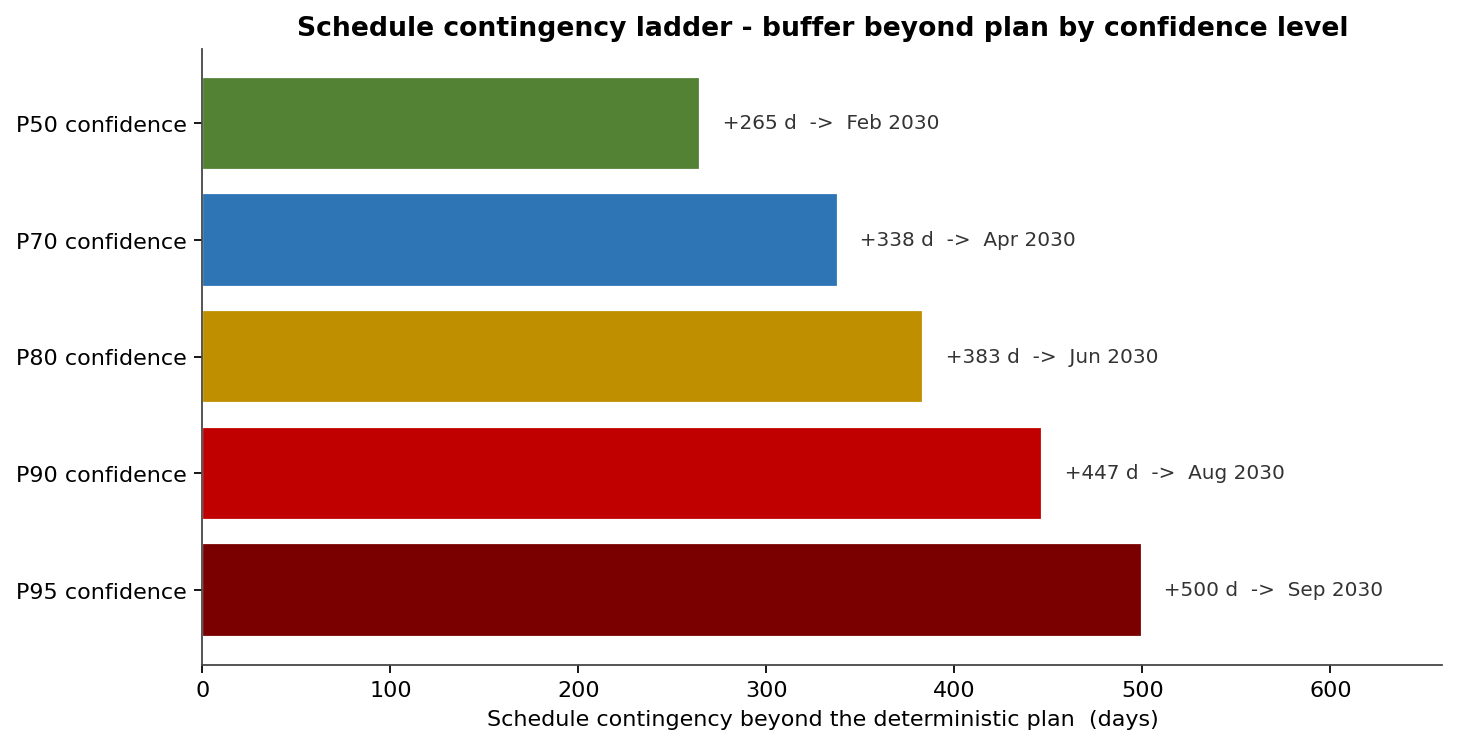
P50 needs +265 days (finish 1,345), P70 +338 (1,418), P80 +383 (1,463), P90 +447 (1,527) and P95 +500 (1,580). A stakeholder-mitigation package — a dedicated liaison office, a parallel-review process and an early community-outreach programme — cuts gate-delay probabilities and spreads, trimming the P80 finish by 144 days (1,463 → 1,319). Because schedule drives cost, the cost falls from a mean of $399M / P90 $488M to a P90 of $415M, and the overrun probability drops from 19% to 2%. Investing in stakeholder communication is, on these numbers, one of the cheapest schedule buys available.
What Tamara Changed
- A risk-informed P80 replaced the 1%-likely May 2029 plan, giving the team a defensible date to negotiate with the funder and the community.
- Sign-off gates were exposed as the top schedule drivers — the funding-release gate (cruciality 0.41) out-ranked the construction package on the criticality scatter.
- The 19% chance of being late AND over budget was quantified, forcing cost and schedule to be managed as one risk.
- A liaison-office and outreach package was approved on its tail-clipping effect, cutting budget-overrun probability from 19% to 2%.
Tamara Functionality Used
- Monte Carlo schedule simulation over a network of work packages interleaved with approval gates.
- Cumulative S-curve and contingency-ladder analysis turning the finish distribution into a confidence-based commitment date and buffer.
- Discrete risk-event modelling (Bernoulli occurrence × Triangular impact) for stakeholder-gate stalls.
- Criticality and cruciality analysis showing a sign-off gate out-ranking the construction package.
- Joint cost–schedule analysis quantifying the probability of being late and over budget at once.
- Scenario comparison quantifying the stakeholder-mitigation package's before/after impact on both the P80 finish and the overrun probability.
On a multi-stakeholder project the schedule is not set by the build; it is set by who signs, and when. Tamara is what turns that political reality into a probability the project, the funder and the community can all plan against.