

Regulatory compliance risks
A regulatory submission-to-approval programme is a schedule dominated by agency review clocks and the risk of information requests, inspections and resubmissions. At heart it is a buffer problem: miss the launch window and the cost is deferred revenue, not just overtime. The question is not "when will we finish?" but "how many days of buffer do we need to be safe?" This case study runs a Tamara schedule-risk model of an 11-activity submission-to-approval programme - data lock and dossier modules through QA, filing, the review cycle, inspection and labelling - to size that buffer at every confidence level.
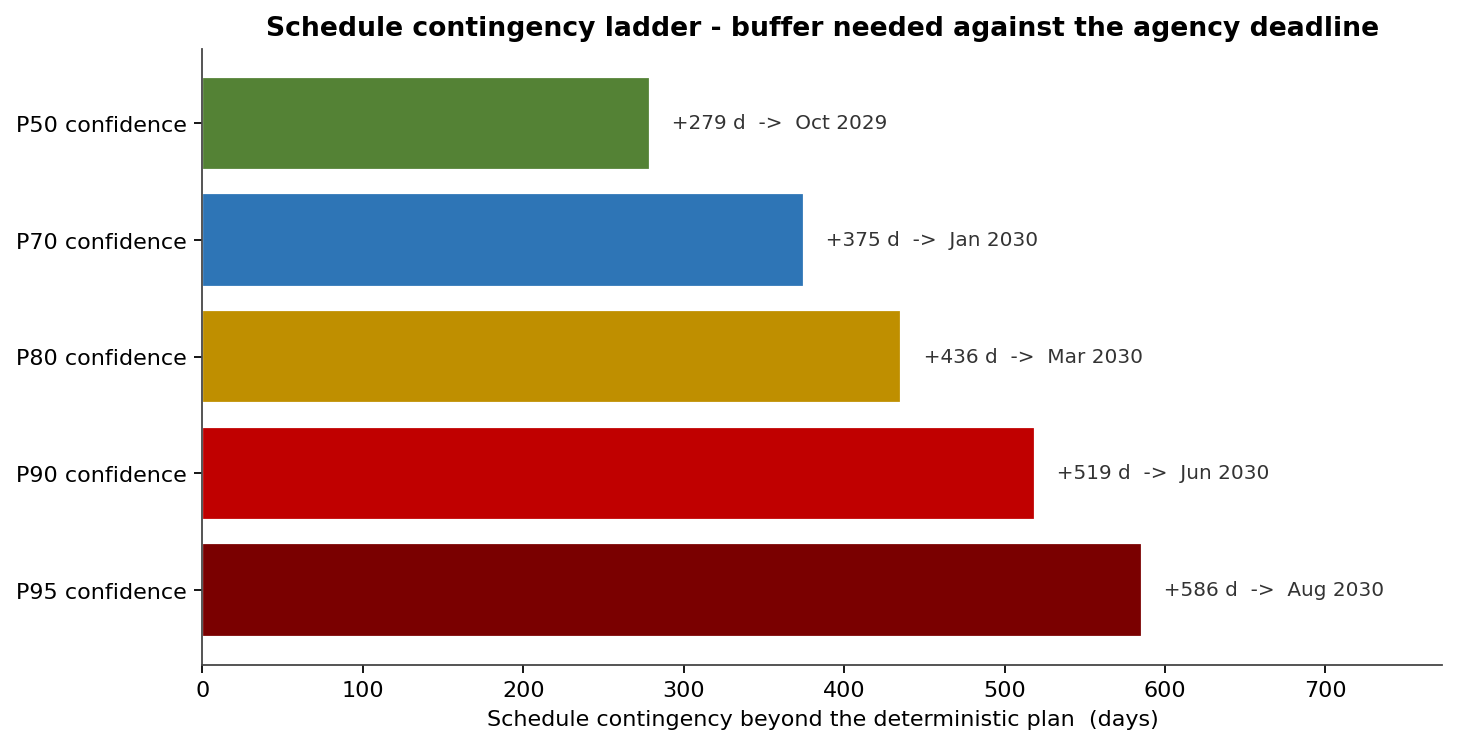
The contingency ladder is the headline. Against a 1,080-day deterministic plan, hitting P80 needs 436 days of buffer (a 1,516-day total); P90 needs 519 days and P95 needs 586 days. Even a P50 commitment carries a 279-day buffer. Pick the rung that matches your tolerance for missing the launch date.
The model
Eleven activities with three-point PERT durations on a critical-path network, plus six discrete compliance risk events - a major information request (CRL), inspection findings, resubmissions, guideline rework, review-clock extensions and labelling disputes. One Monte-Carlo of 60,000 iterations drives every chart.
P80 approval needs 436 days of buffer
The ladder's rungs read as a decision table: P50 +279 days, P70 +375, P80 +436, P90 +519 and P95 +586 days beyond the deterministic plan. The plan itself is beaten in only 2% of simulations.
The full confidence curve
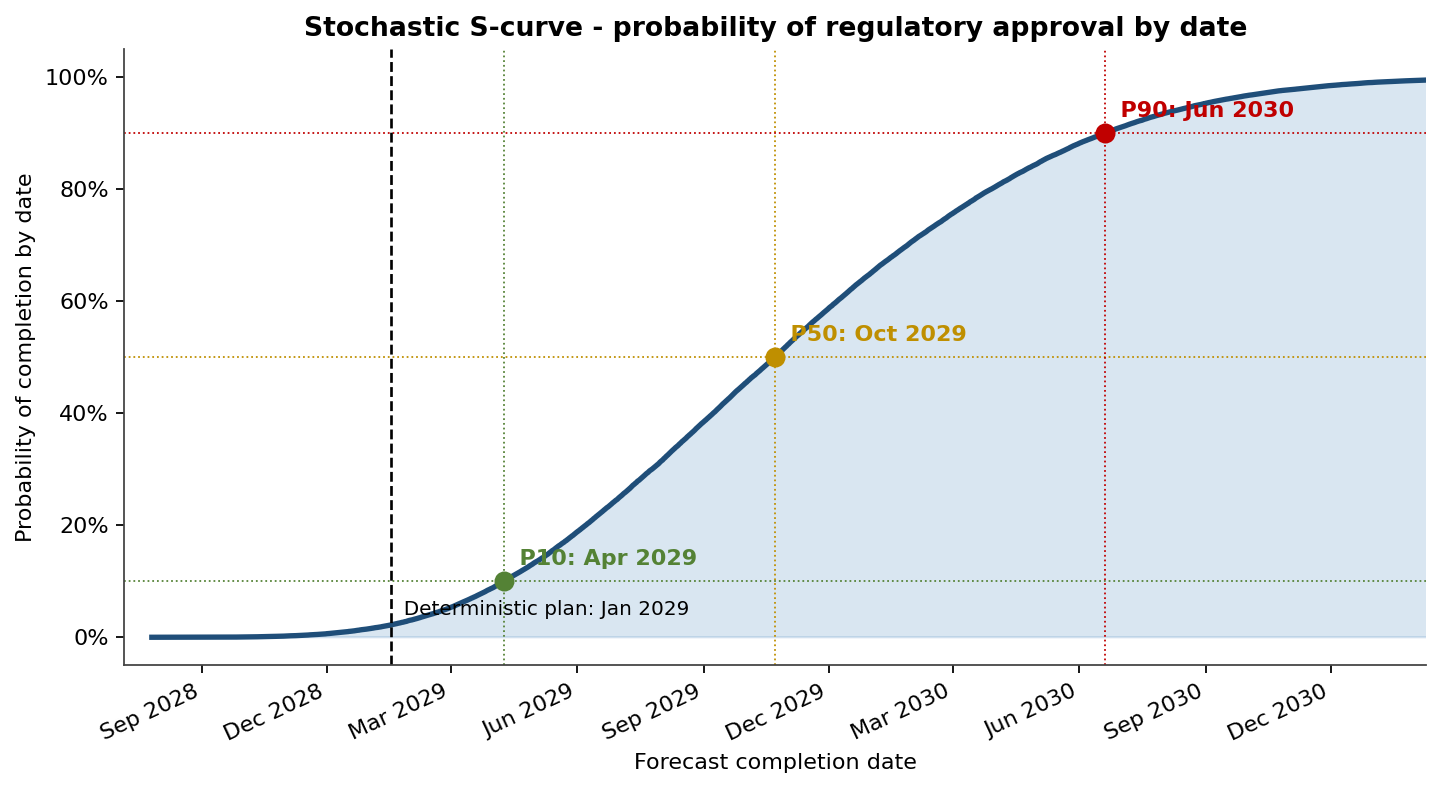
The S-curve is the ladder's continuous form: read the approval date at any confidence level. The P50 sits at 1,359 days, P80 at 1,516 and P90 at 1,599, with the deterministic 1,080-day plan marked well to the left of P80.
Information requests own the approval date at 0.67 cruciality
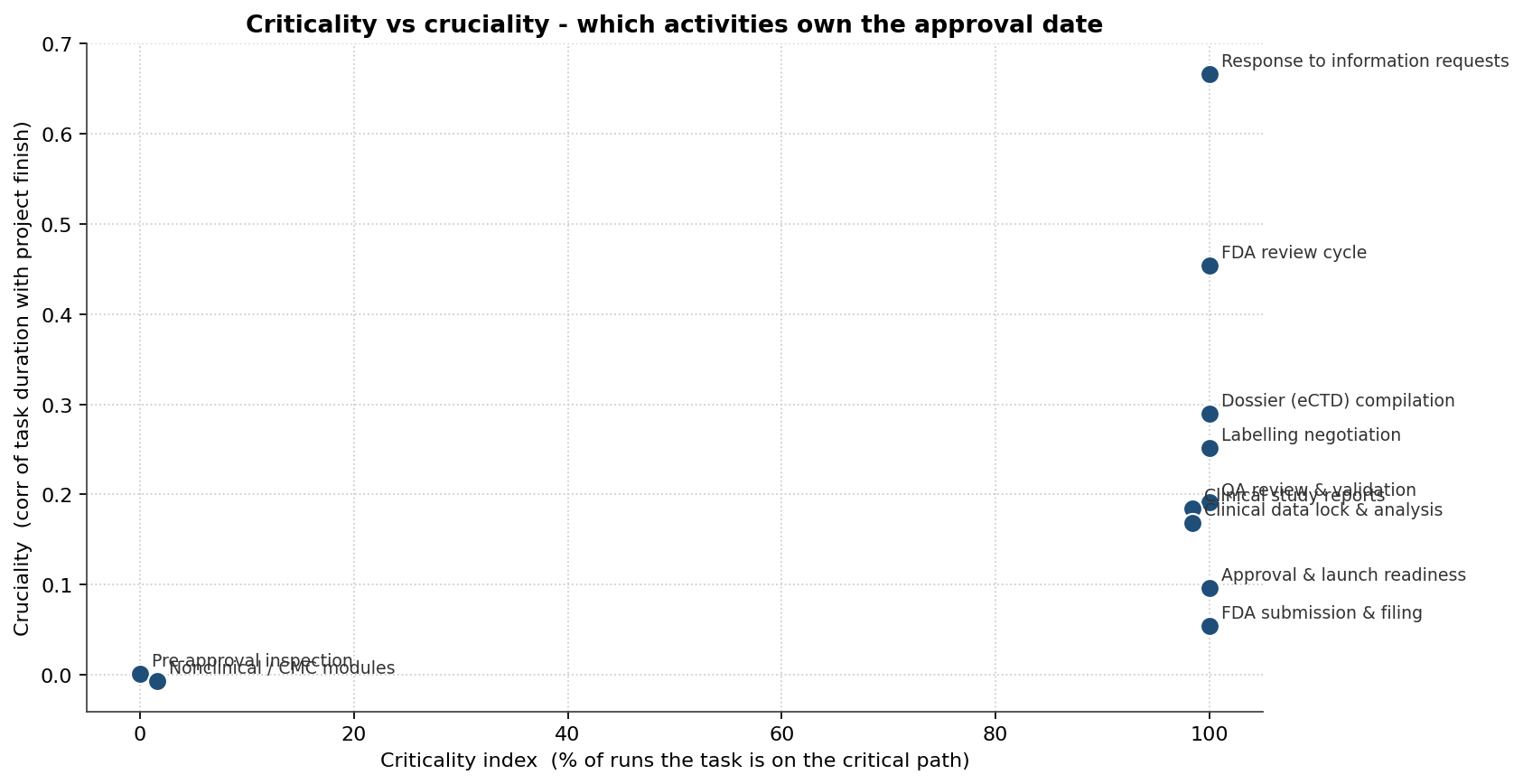
The criticality-vs-cruciality scatter places each activity by how often it sits on the critical path against how strongly its duration correlates with the approval date. Response to information requests is the standout in the top-right - critical in 100% of runs with a cruciality of 0.67 - the controllable lever (response speed and completeness) that moves the approval date more than the review clock the team treats as fixed.
Approval slip drives cost - 36% over budget
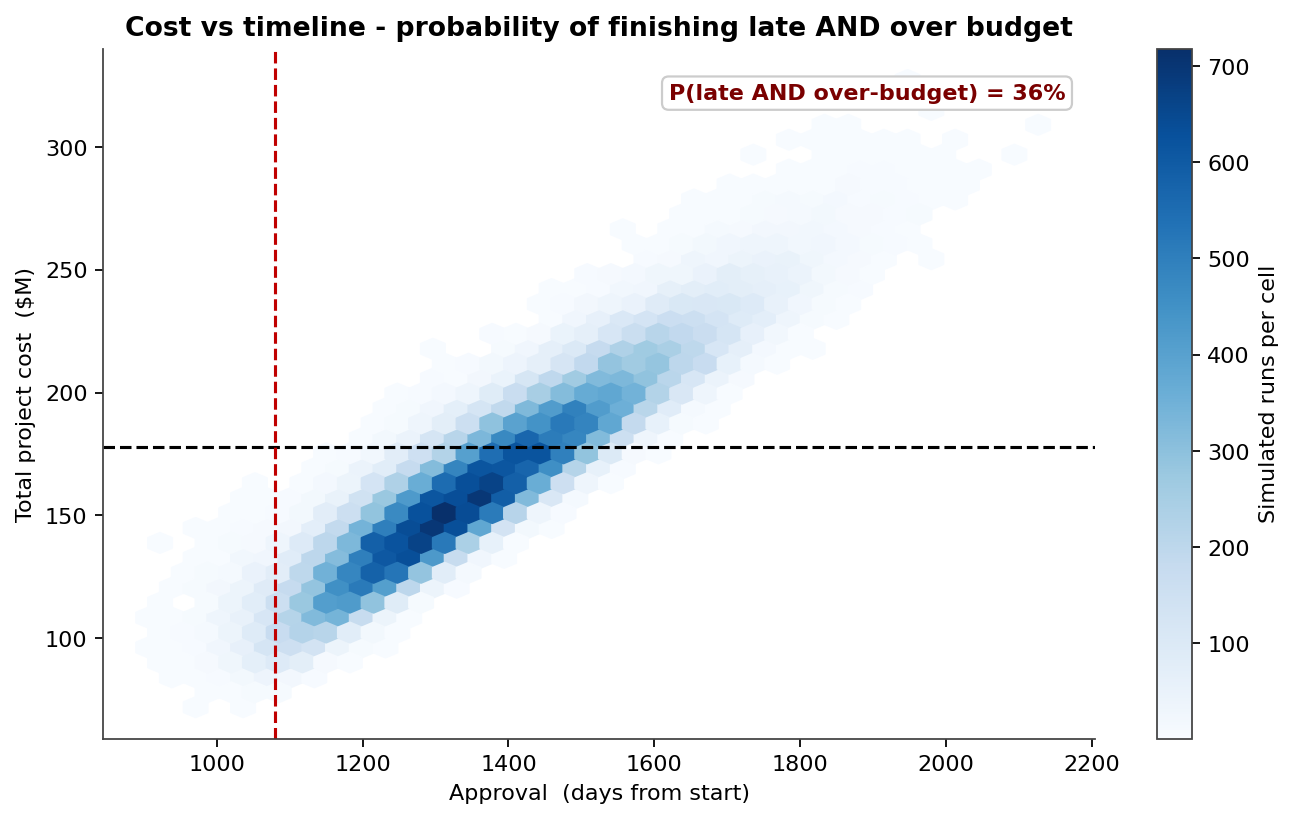
Cost is schedule-linked: every day to approval past plan defers launch and burns about $0.20M of regulatory-affairs and launch-readiness overhead, so cost and timeline overrun together. The joint density shows 36% of runs finishing both late and over the $178M budget; at P80 the programme reaches 1,516 days and $197M, already $19M past budget. The cost mean is $166M with a P90 of $216M.
Where the discrete-risk delay concentrates
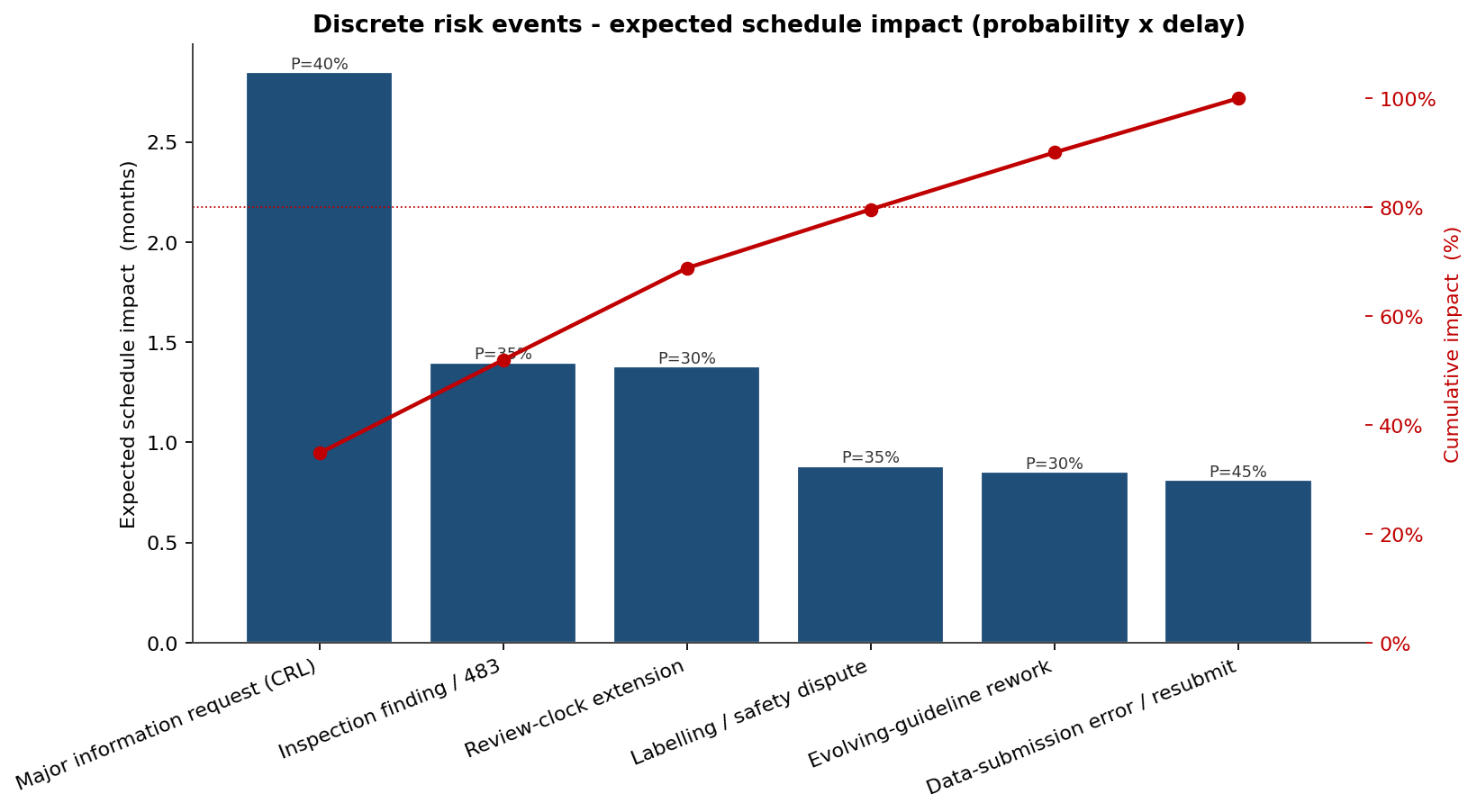
The Pareto ranks the discrete risk events by expected schedule impact. The major information request (CRL) dominates at 2.8 expected months - double the next events, inspection finding and review-clock extension at 1.4 months each; the top five of six events carry ~80% of the expected discrete-risk delay.