

Industry: Engineering
Product: Tamara
Application: Material procurement risks
The Plan Said 995 Days. To Commit at 80% Confidence the Bridge Needs a Full Year of Contingency
A cable-stayed bridge worth roughly half a billion dollars was scheduled the orthodox way: a twelve-activity most-likely roll-up that put completion at day 995. What that schedule could not show was how much buffer the date actually needed. The bridge's timeline was dominated not by construction labour but by an international material supply chain — steel girders, stay cables and precast segments fabricated overseas, then shipped, cleared through customs and erected. When the critical path runs through a fabrication yard on another continent, the practical question is not "will we be late" but "how much contingency must we carry to commit to a date with confidence."
Rebuilt in Tamara, Vose Software's Monte Carlo project risk tool, with Beta-PERT durations on every activity and six discrete risk events layered on top, the answer is a ladder. The contingency ladder is the headline of this case — it reads off the buffer beyond the deterministic plan each confidence level requires:
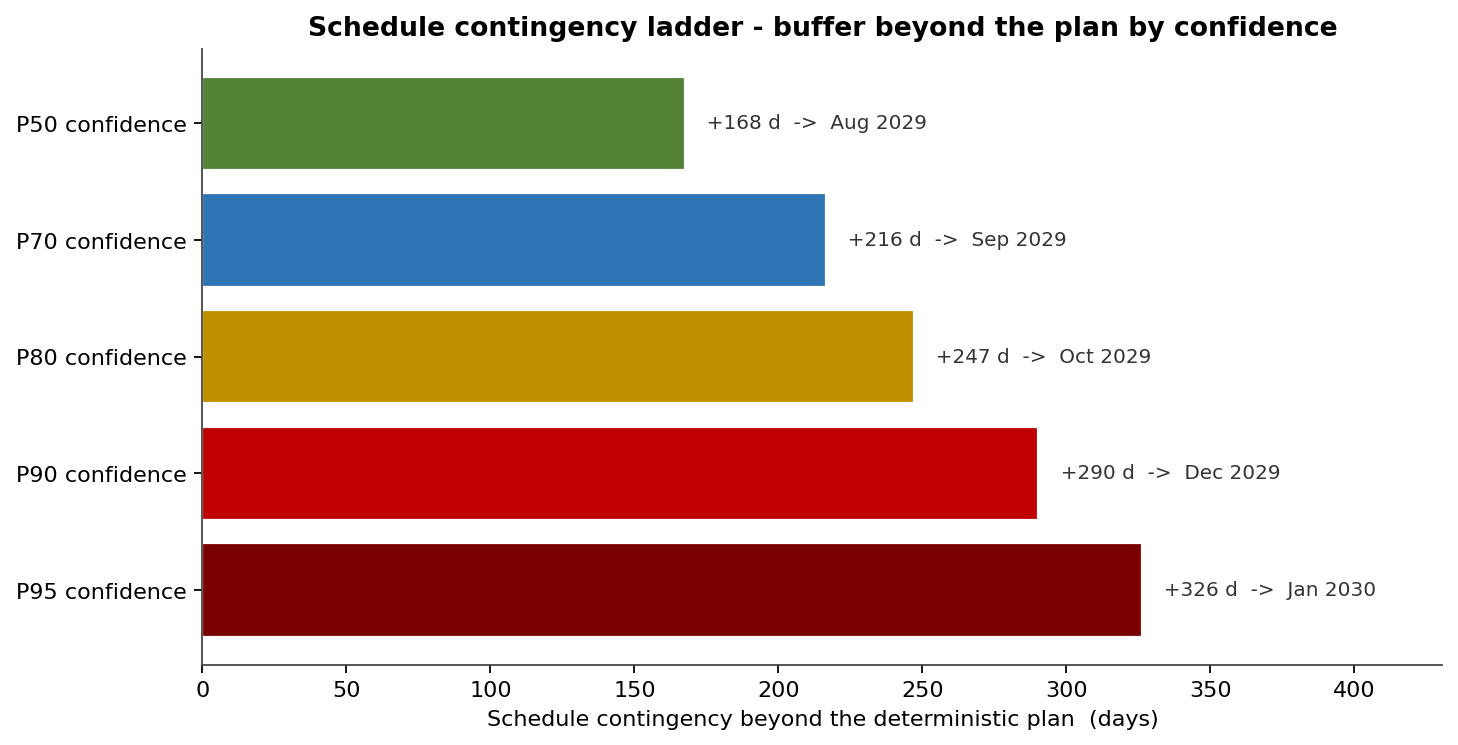
| Confidence | Buffer beyond plan | Completion day |
|---|---|---|
| P50 | +168 days | 1163 |
| P70 | +216 days | 1211 |
| P80 | +247 days | 1242 |
| P90 | +290 days | 1285 |
| P95 | +326 days | 1321 |
Even the P50 already demands 168 days of buffer, and an 80%-confident commitment needs 247 days — about 8.1 months over the headline plan. The deterministic plan is not a target; it is the optimistic corner.
Only a 2% chance of meeting the plan
The same simulation produces the full distribution of the completion date, and it shows why the ladder climbs so steeply:
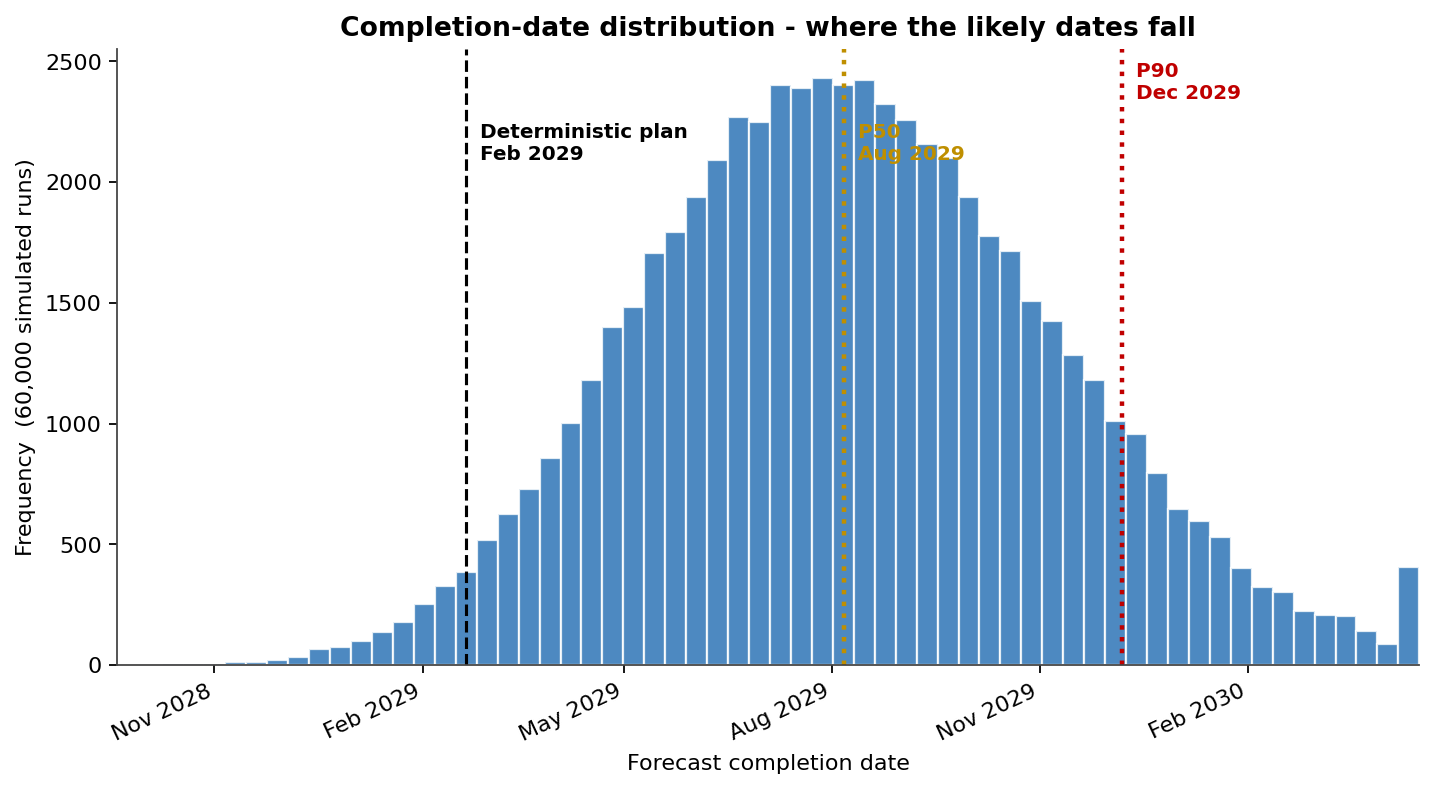
The mass sits far to the right of the deterministic plan: the P50 is day 1163 and the P90 day 1285, against a deterministic day 995 with only a 2% chance of being met. The mean simulated finish is 1,166 days, because the procurement streams (girders, cables, precast segments) run in parallel and then converge — so whichever supply chain is slowest in a given iteration drives the finish, and the project inherits the worst of several chains, not the average of one.
Which procurement items to de-risk
Tamara reports each activity's criticality index (how often it lands on the critical path) and its cruciality (how strongly its duration moves the finish), and plots one against the other. The top-right corner is the de-risk shortlist:
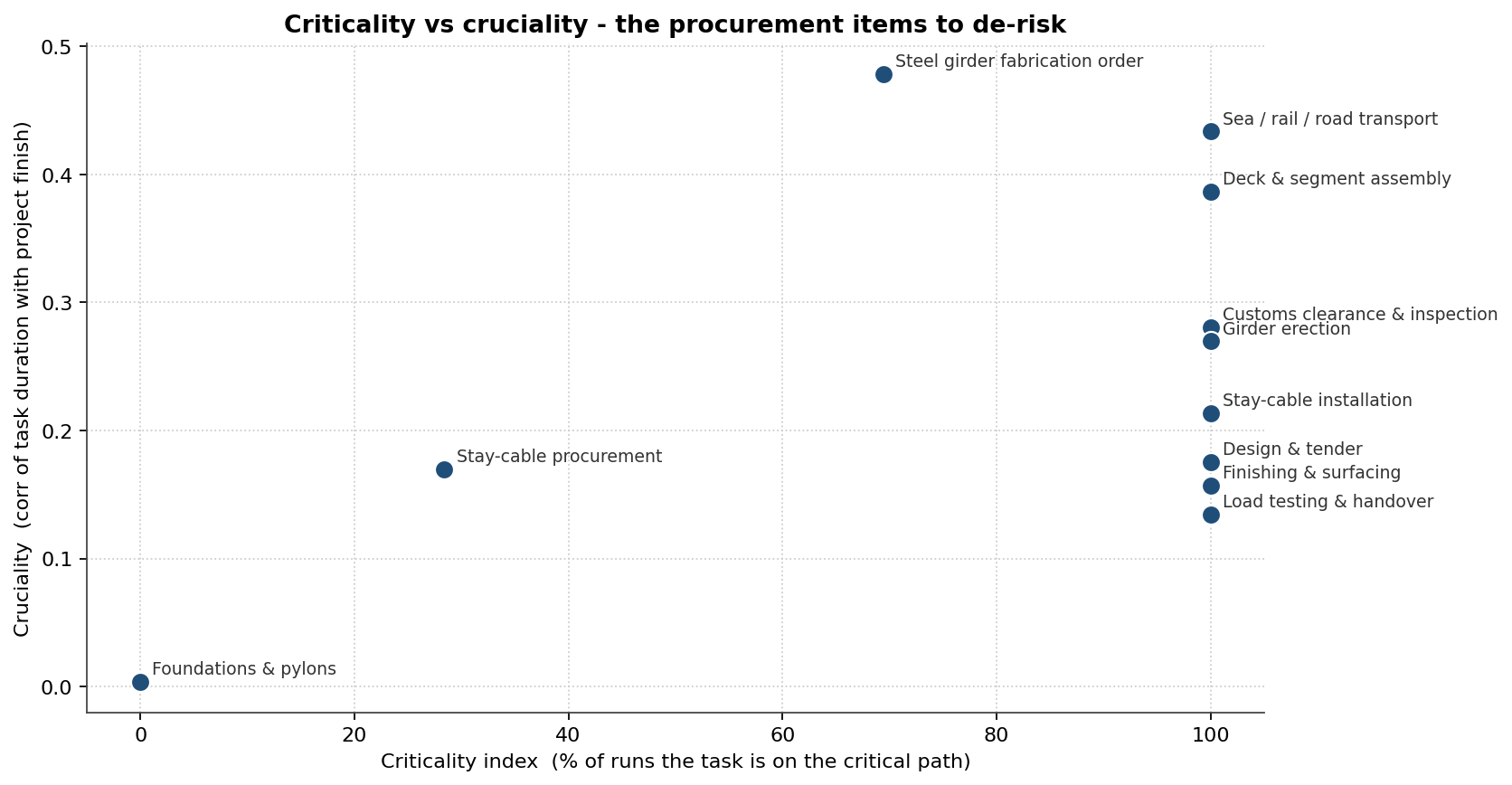
Steel girder fabrication dominates (cruciality 0.48), followed by sea/rail/road transport (0.43) and deck and segment assembly (0.39). The first two are procurement and logistics — not site activities — confirming that the highest-leverage week of risk reduction is spent in the supply chain, dual-sourcing the steel order and securing freight, rather than accelerating work on the deck.
What mitigation is worth
Every day beyond the deterministic plan carries financing carry and liquidated-damages exposure, so the schedule distribution drives the cost distribution. Tamara let the team price a mitigation package — dual-sourcing the steel order, booked/expedited freight, a partial steel-price hedge and early customs-broker engagement — and compare before/after on the same axis:
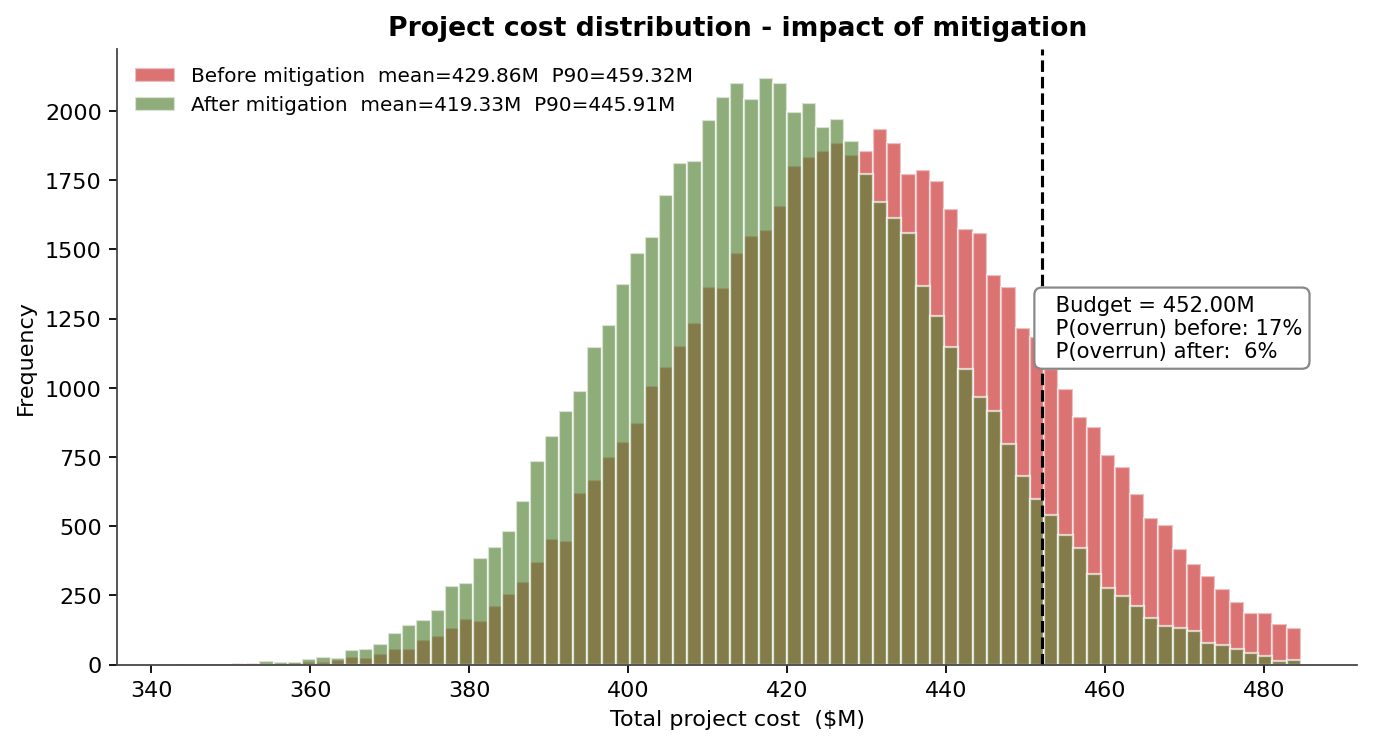
Without mitigation the all-in cost runs to a mean of $430M and a P90 of $459M, with a 17% probability of breaching the $452M budget. The mitigation package cuts the P80 finish by 70 days (1,242 → 1,172 days), and because schedule drives cost, the overrun probability falls from 17% to 6% — value that lands largely in avoided carry and damages rather than in the procurement line items the package touches directly.
The discrete risks that drive the tail
The six discrete events were modelled as Bernoulli risks. Ranking them by expected schedule impact (probability × delay) gives a clean Pareto:
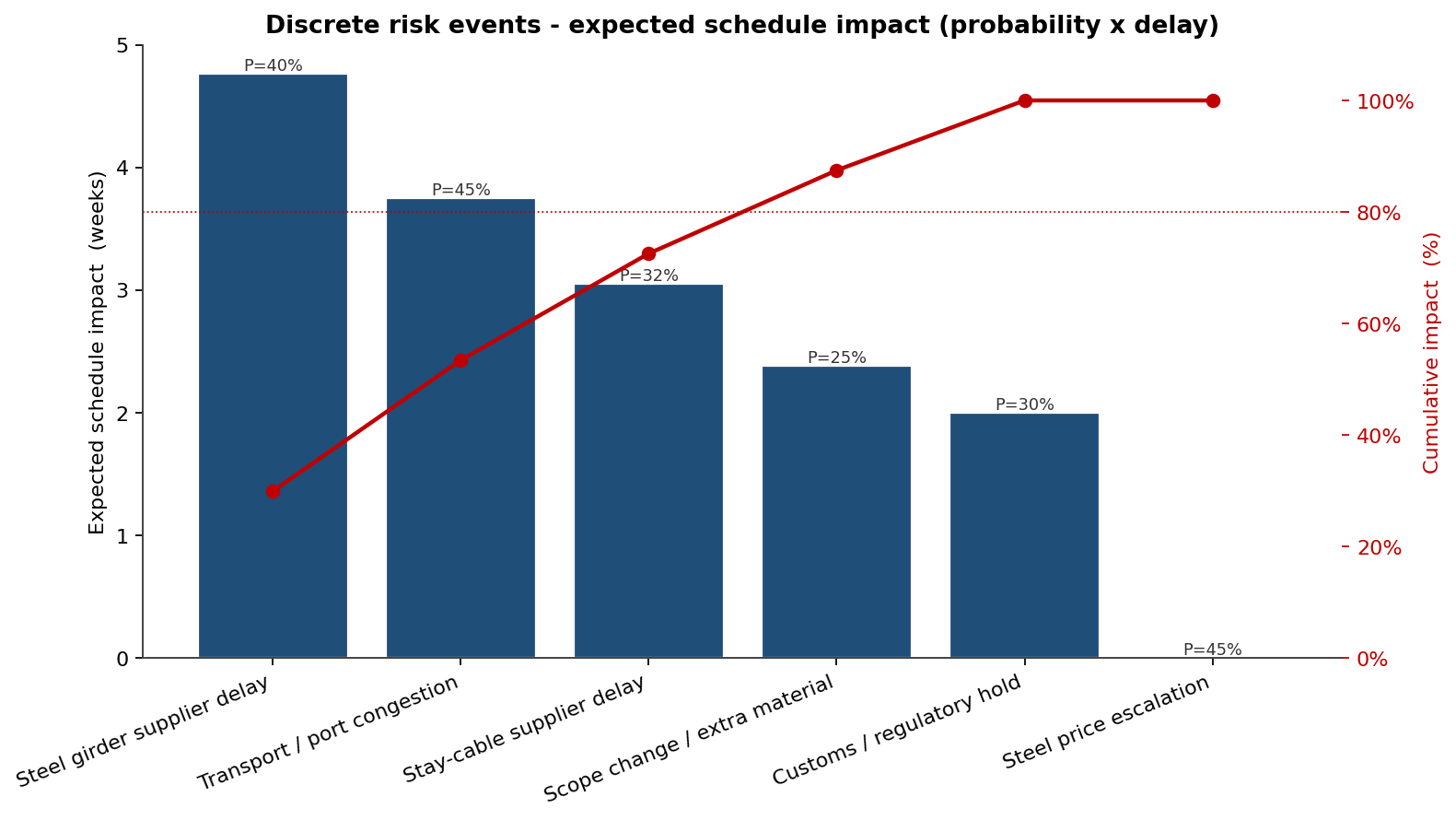
Four of the six events carry ~80% of the expected discrete-event delay — a steel girder supplier delay (4.8 weeks expected), transport/port congestion (3.8), a stay-cable supplier delay (3.0) and a scope change requiring extra material (2.4). Steel price escalation carries no schedule impact — it is a pure cost risk, and the Pareto isolates it correctly. Every leading schedule risk is a procurement or logistics risk, which is the case study in one chart.
What Tamara changed
- The commitment moved from the deterministic day-995 plan to a risk-informed contingency ladder, exposing the 247-day buffer an 80% commitment actually needs.
- An 8.1-month schedule contingency was quantified and funded, rather than discovered one slipped shipment at a time.
- Risk-reduction effort was concentrated on the steel supply chain and freight — the two highest-cruciality drivers, both off-site — instead of on construction labour.
- A mitigation package was approved on its tail-clipping effect, cutting budget-overrun probability from 17% to 6%.
Tamara Functionality Used
- Monte Carlo schedule simulation over the full activity network, with Beta-PERT durations and parallel supply-chain logic.
- Contingency-ladder and finish-date distribution analysis quantifying the buffer each confidence level requires.
- Discrete risk-event modelling (Bernoulli occurrence × Triangular impact) on durations and costs, including a pure cost-only steel-price risk.
- Criticality and cruciality analysis distinguishing how often an activity is critical from how much its variability moves the finish date — surfacing procurement as the dominant driver.
- Integrated cost–schedule modelling linking finish-date slip to financing carry and liquidated-damages cost.
- Scenario comparison quantifying a procurement mitigation package's before/after impact on both the P80 finish and the budget-overrun probability.
When the critical path runs through a supply chain, the schedule is a procurement question. Tamara is what turns "when will the material arrive?" into a probability the firm and its client can both plan against.