

Industry: Biotech
Product: Tamara
Application: Clinical trial risk assessment
One Risk Carries More Delay Than the Next Two Combined: Recruitment
A Phase II rare-disease trial — protocol finalisation through database lock — was scheduled the orthodox way: eleven activities, each with a most-likely duration, chained through the network and read off the end as a clean August 2028 database lock, the gate to a pivotal readout the company carried to its board and its investors. But a single end date says nothing about which of the things that can go wrong actually governs it. A trial lives or dies on a handful of discrete risks — ethics delay, recruitment shortfall, amendments — and the first job of a risk model is to rank them, because the response budget is finite and most of it should go to one place.
Rebuild the trial in Tamara, Vose Software's Monte Carlo project risk tool, with Beta-PERT durations and six discrete risk events, and rank those events by expected schedule impact (probability x delay). The Pareto is unambiguous:
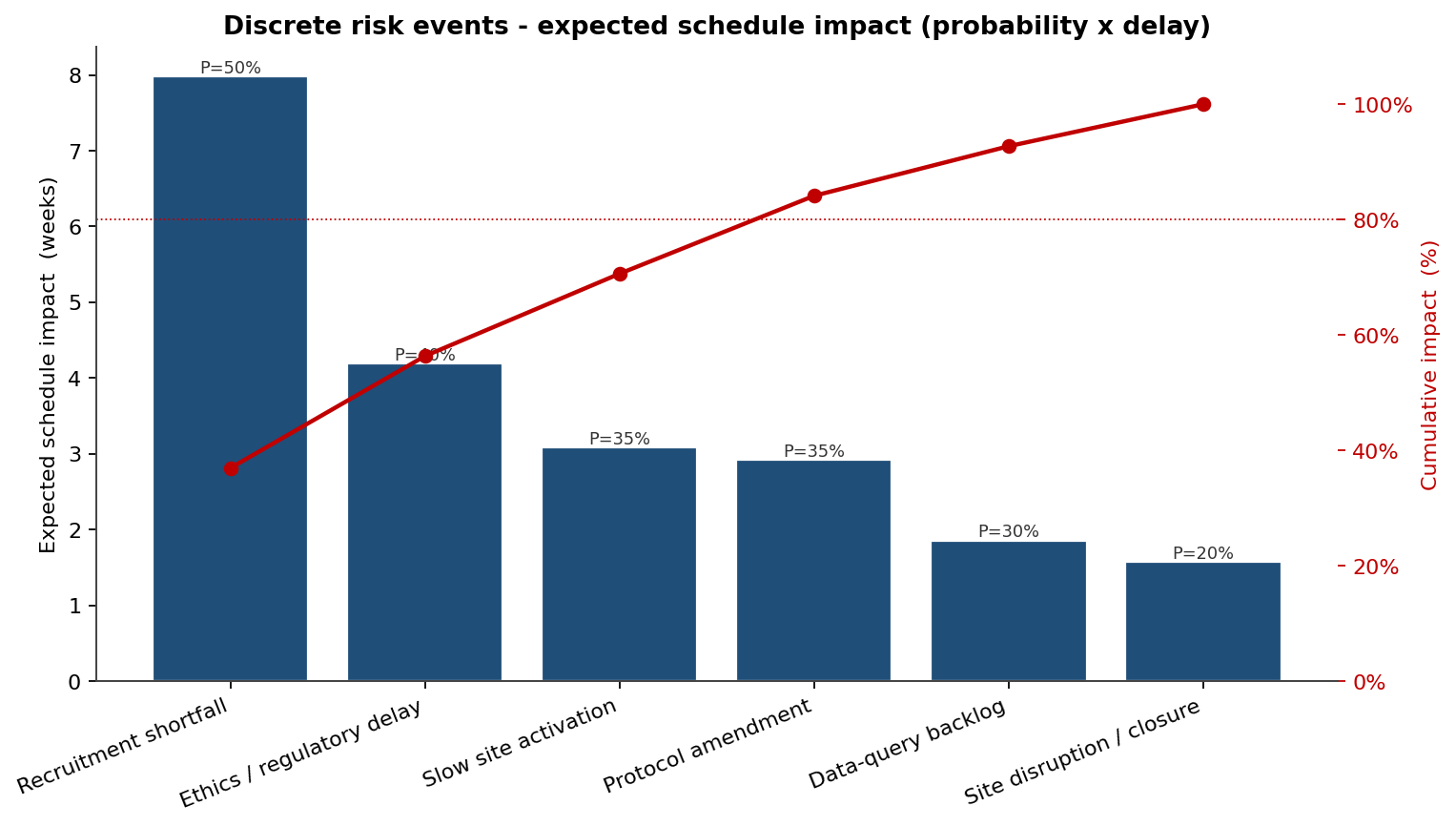
A recruitment shortfall carries 8.0 weeks of expected delay — more than the next two risks combined. Behind it sit an ethics / regulatory delay (4.2 weeks), slow site activation (3.1) and a protocol amendment (2.9); four of the six events account for roughly 80% of all expected discrete-event delay. This is the clearest action list in the portfolio: recruitment is not one risk among six, it is the risk, and every dollar of response budget belongs there before anywhere else. The ranking turns a flat risk register into a priority order the trial team can fund top-down.
How much schedule contingency the ranking implies
Those risks, compounded across the network, push the lock date far past the plan — and the contingency ladder says exactly how far, at each confidence level the company might commit against:
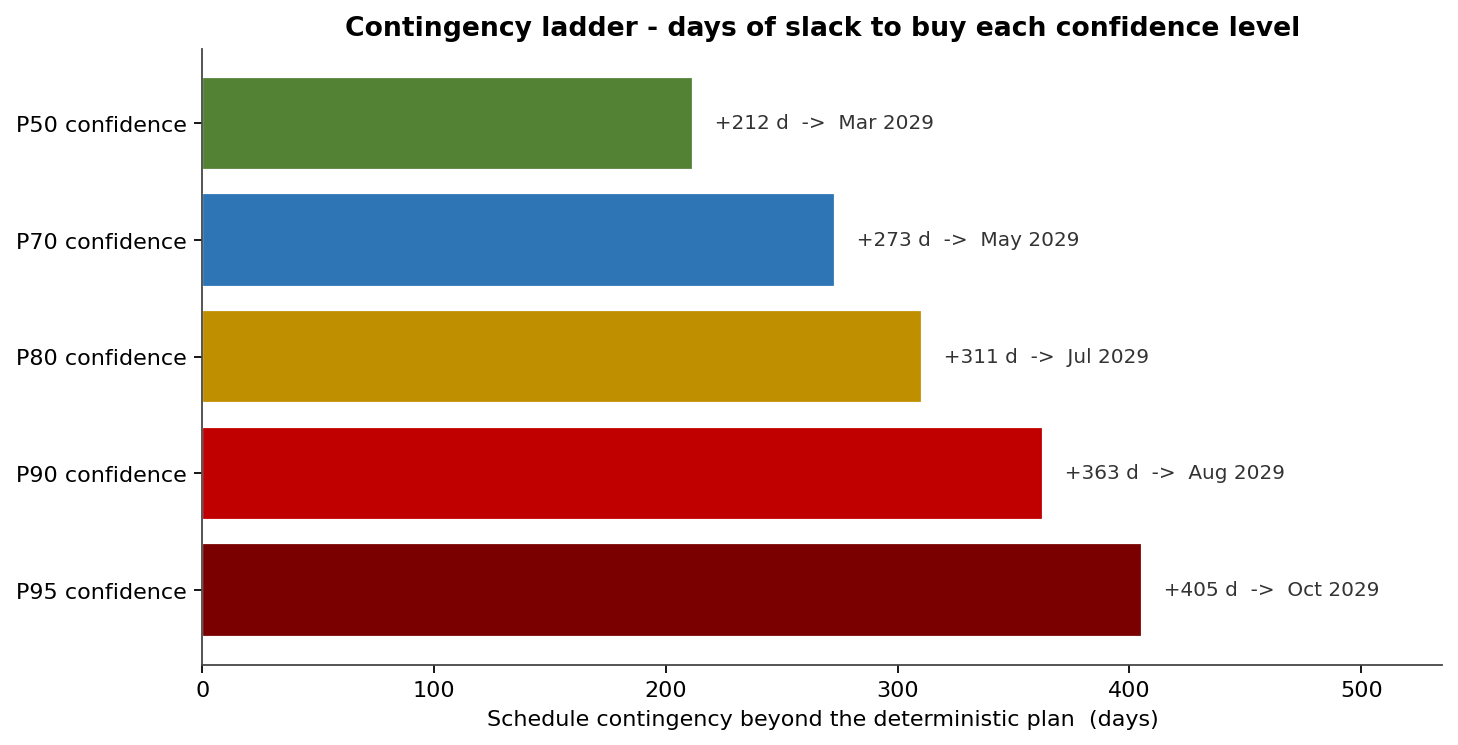
Against the 905-day deterministic plan, a P50 commitment needs +212 days (finishing day 1,117), P80 needs +311 days (day 1,216 — roughly 10.2 months of contingency), and a near-certain P95 needs +405 days (day 1,310). Each rung is a decision the board can make on the record rather than discover one stalled recruitment month at a time. The August 2028 plan has just a 2% chance of being met.
Where the continuous duration risk lives
The Pareto ranks the discrete events; a criticality scatter ranks the activities themselves, plotting how often each is on the critical path against how much its variability moves the finish:
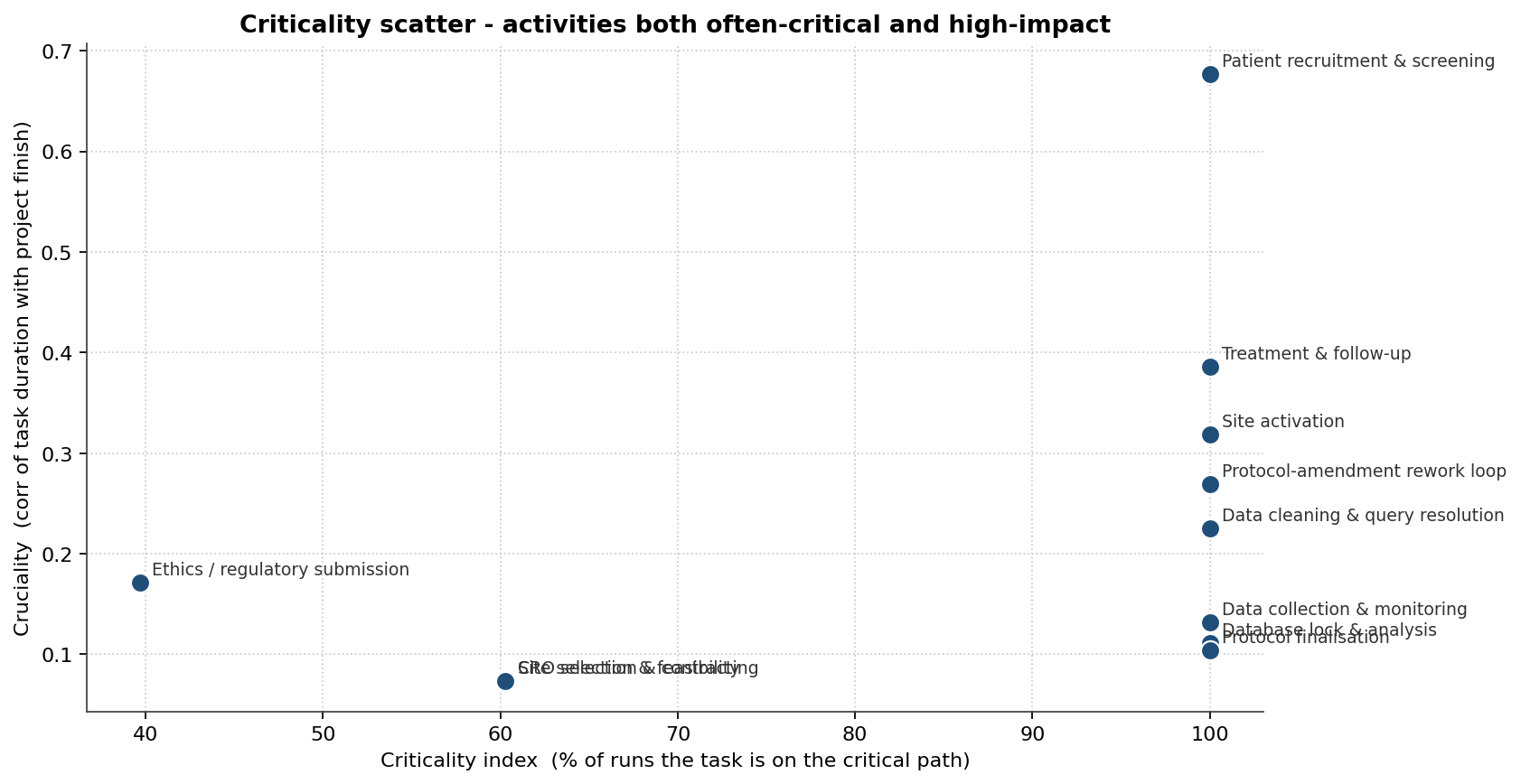
Patient recruitment and screening dominates the impact axis at cruciality 0.68 — far ahead of treatment and follow-up (0.39) and site activation (0.32). The data-management tail (data collection, cleaning, database lock) sits on the critical path in essentially 100% of iterations — always critical — yet its variability barely moves the finish, so it clusters low on the impact axis. The scatter makes the lesson explicit: being always-critical is not the same as being worth de-risking, and recruitment is the single dominant lever by both the discrete and the continuous analysis. The two views point at the same target.
Schedule risk is cost risk — on the same axes
Every day the trial runs long carries CRO retainer, site maintenance and per-patient management overhead, so a late trial is an over-budget trial. Plotting each simulated run in the finish-date / total-cost plane shows the coupling directly:
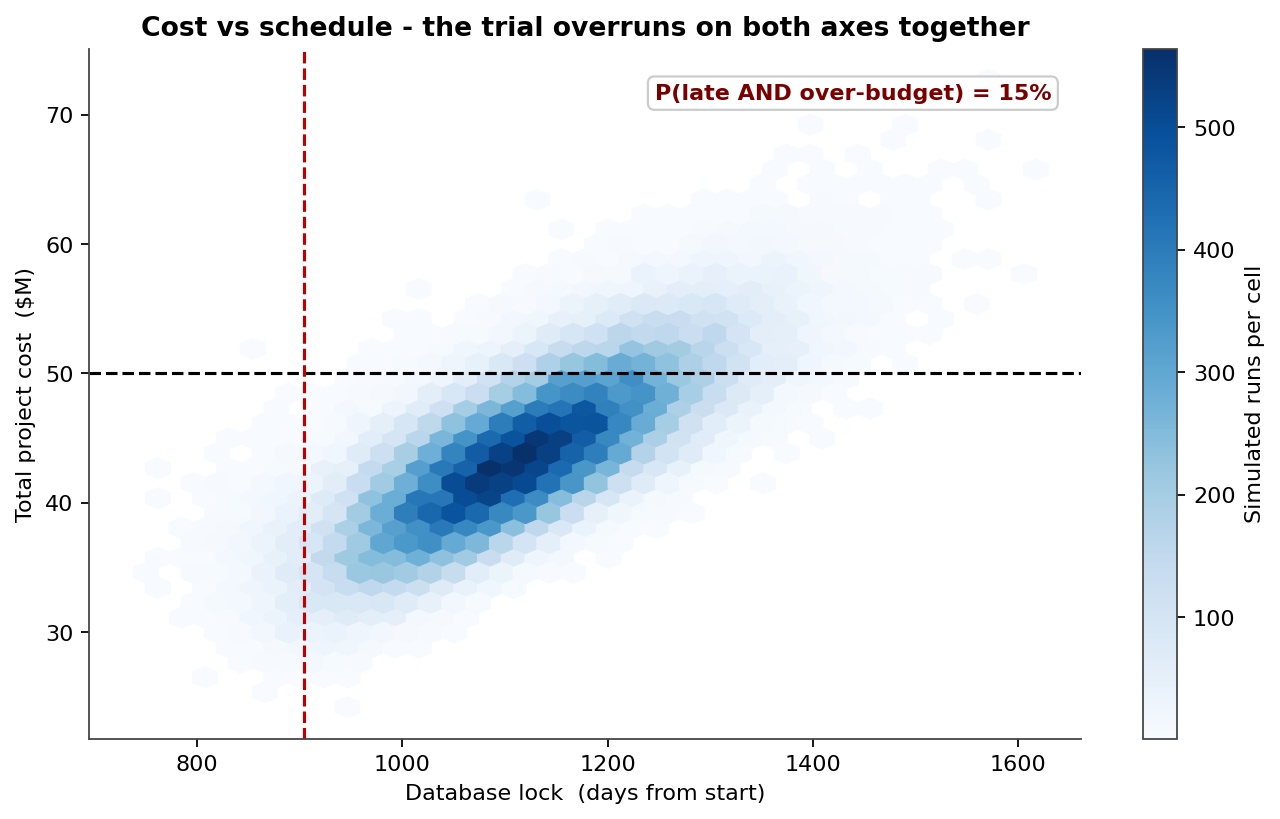
The cloud runs diagonally — late runs are over-budget runs — and in 15% of simulations the trial finishes both late AND over the $50M budget, in the dangerous upper-right quadrant. Pricing three mitigations together (parallel multi-region ethics filing, patient-finder and advocacy partnerships with added sites to attack the recruitment shortfall, and a pre-agreed statistical analysis plan that cuts amendment churn) cuts the P80 finish by 99 days (1,216 to 1,117 days) and, because schedule drives cost, takes the overrun probability from 15% to 2% — the $1.8M package pays for itself several times over in avoided retainer cost, not in the line items it touches directly.
The full lock-date distribution
The cumulative S-curve collapses all of the above onto the single axis the board ultimately commits against:
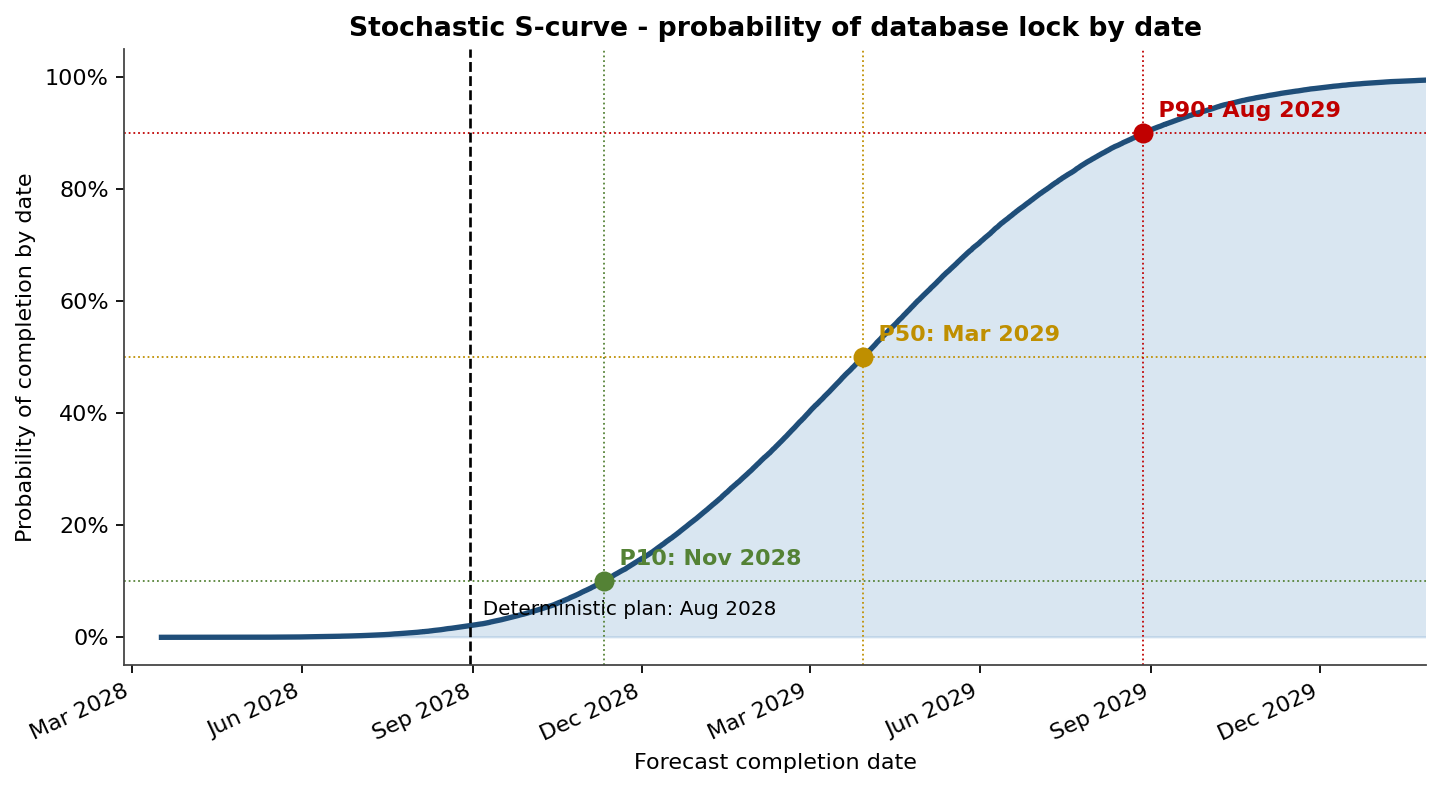
The deterministic plan sits at the very foot of the curve; the body runs from P50 March 2029 to P90 August 2029, with a mean of 1,120 days against the 905-day plan. Read off any confidence level and the curve returns a date the company can actually defend.
What Tamara changed
- The response budget was concentrated on patient recruitment — the dominant discrete risk (8.0 weeks) and the dominant continuous driver (cruciality 0.68) — instead of spread evenly across the risk register.
- A contingency level was chosen from the ladder (+311 days for P80), fixing the schedule reserve and, through the cost coupling, the budget reserve.
- The external commitment moved from the deterministic August 2028 date to a risk-informed P80, ending the rolling-promise cycle with the board and investors before it started.
- A $1.8M mitigation package was approved on its tail-clipping effect, cutting budget-overrun probability from 15% to 2%.
Tamara Functionality Used
- Monte Carlo schedule simulation over the full trial network, with Beta-PERT durations and parallel-path logic.
- Discrete risk-event Pareto (Bernoulli occurrence x Triangular impact) ranking recruitment shortfalls, regulatory delay and amendments by expected schedule impact.
- Contingency ladder translating each confidence level into committed days of schedule reserve.
- Criticality and cruciality analysis plotting how often an activity is critical against how much its variability moves the lock date.
- Joint cost-schedule density showing, per simulated run, that finish-date and cost overruns occur together, plus scenario comparison of the mitigation package on the P80 finish and overrun probability.
- Cumulative S-curve for communicating schedule uncertainty to non-technical stakeholders.
A clinical trial is not a date; it is a distribution governed by a handful of rankable risks — recruitment above all. Tamara is what turns "when do we lock?" into a priority order and a probability the board, the investors and the trial team can all sign.