

Industry: Real Estate
Product: ModelRisk
Application: Evaluating the Impact of Zoning Regulations on Real Estate Development
A $14M Density Bonus Behind a 55% Approval Vote — Positive Expected Value, 49% Chance of Paying Off
The developer can apply to upzone the site — raise the allowed floor-area ratio and density — for a land-value uplift the spreadsheet pencils at $14M. The catch is that the uplift only exists if the rezoning is approved, and approval is a contested political outcome, not a certainty. ModelRisk priced the decision as a bet: the prize is an uncertain uplift, the odds are an uncertain approval probability, and even a win comes with exactions — affordable set-asides, impact fees, community benefits — while the application costs $1.8M whether it passes or fails. The result: the rezoning has a positive expected value of +$4.1M versus building as-of-right, so the decision is to apply — but only a 49% chance of actually being net-positive, and a 51% chance of a net loss. Positive EV and a coin-flip outcome are not a contradiction; they are what a fat right tail looks like.
Why a point estimate fails here
A deterministic model takes the most-likely uplift ($14M), assumes approval, subtracts a point estimate of exactions and cost, and reports a comfortable profit. Every one of those steps hides the actual risk:
- Approval is binary and uncertain. The single biggest determinant of the outcome — does the rezoning pass? — is a yes/no event the point estimate simply assumes away. Treating a 55% vote as a certainty is the error.
- The probability of approval is itself uncertain. "55%" is a best guess about a political body; the realised odds for this application could be anywhere from 25% to 85% depending on the council's composition and mood.
- Approval and exactions are linked. A hostile political climate both approves less often and demands heavier exactions. Modelling them as independent understates the bad-case tail, where the developer wins approval but only after conceding far more than planned.
The decision model
Approval probability — a Beta prior shifted by climate. The per-application approval probability is drawn from a Beta(5.5, 4.5) prior (mean ≈ 0.55) and shifted by a shared political-climate factor of about ±18 points at one sigma. The realised approval probability spans P10 = 0.25 to P90 = 0.85 across futures.
Approved? — a Bernoulli draw on that realised probability. Across the simulation the rezoning is approved in 55% of trials.
Gross uplift — LogNormal, right-skewed. If approved, the density bonus produces a value uplift centred on a $14M median, with a fat upside (a generous FAR grant is worth far more than a stingy one). The mean uplift is $15.6M, P90 $25.4M. A favourable climate nudges the granted density up too.
Exactions — Triangular, climate-linked. Approval carries conditions modelled as Triangular($2M, $5M, $11M), scaled heavier in a hostile climate. Mean exactions are $6.0M. The climate link produces the intended negative correlation between approval probability and exactions (−0.52, verified) — the same hostile council that is least likely to approve extracts the most when it does — and a mild positive correlation between approval probability and uplift (+0.18).
Application cost — $1.8M sunk, paid whether the bid wins or loses.
What the rezoning bet actually pays
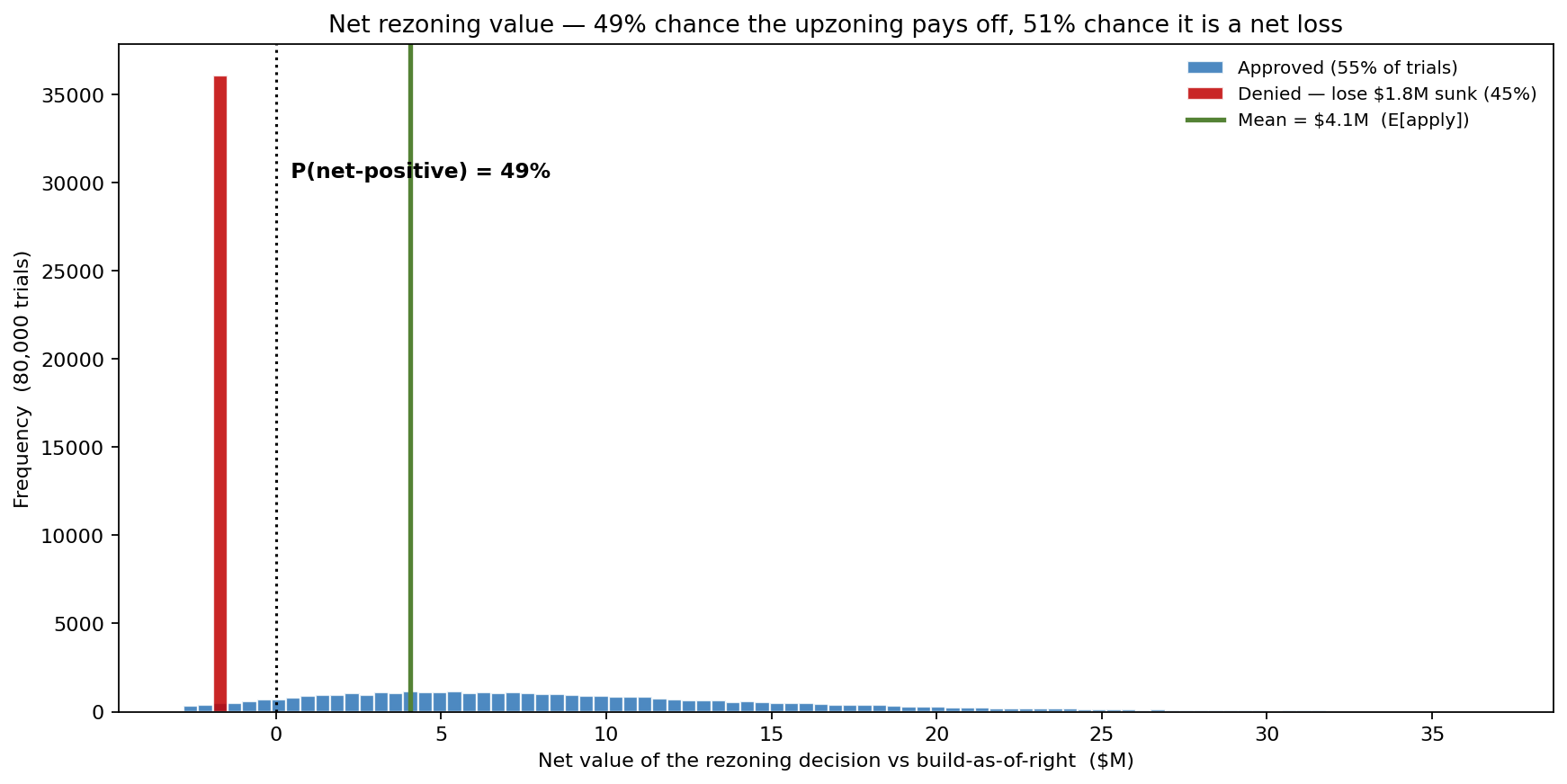
The distribution has two pieces. The 51% of trials where the application is denied collapse to a clean −$1.8M — the sunk application cost, with the developer falling back to building as-of-right. The 55% of trials where it is approved spread into a wide, right-skewed body: uplift minus exactions minus cost. The mean net value is +$4.1M, the median is −$0.7M, and the P90 is +$15.5M. That gap between a positive mean and a slightly-negative median is the signature of the bet: most outcomes are modest or losses, but the fat upside of a big density grant drags the average above zero. P(net-positive) is 49%; P(net loss) is 51%.
Apply, or build as-of-right?
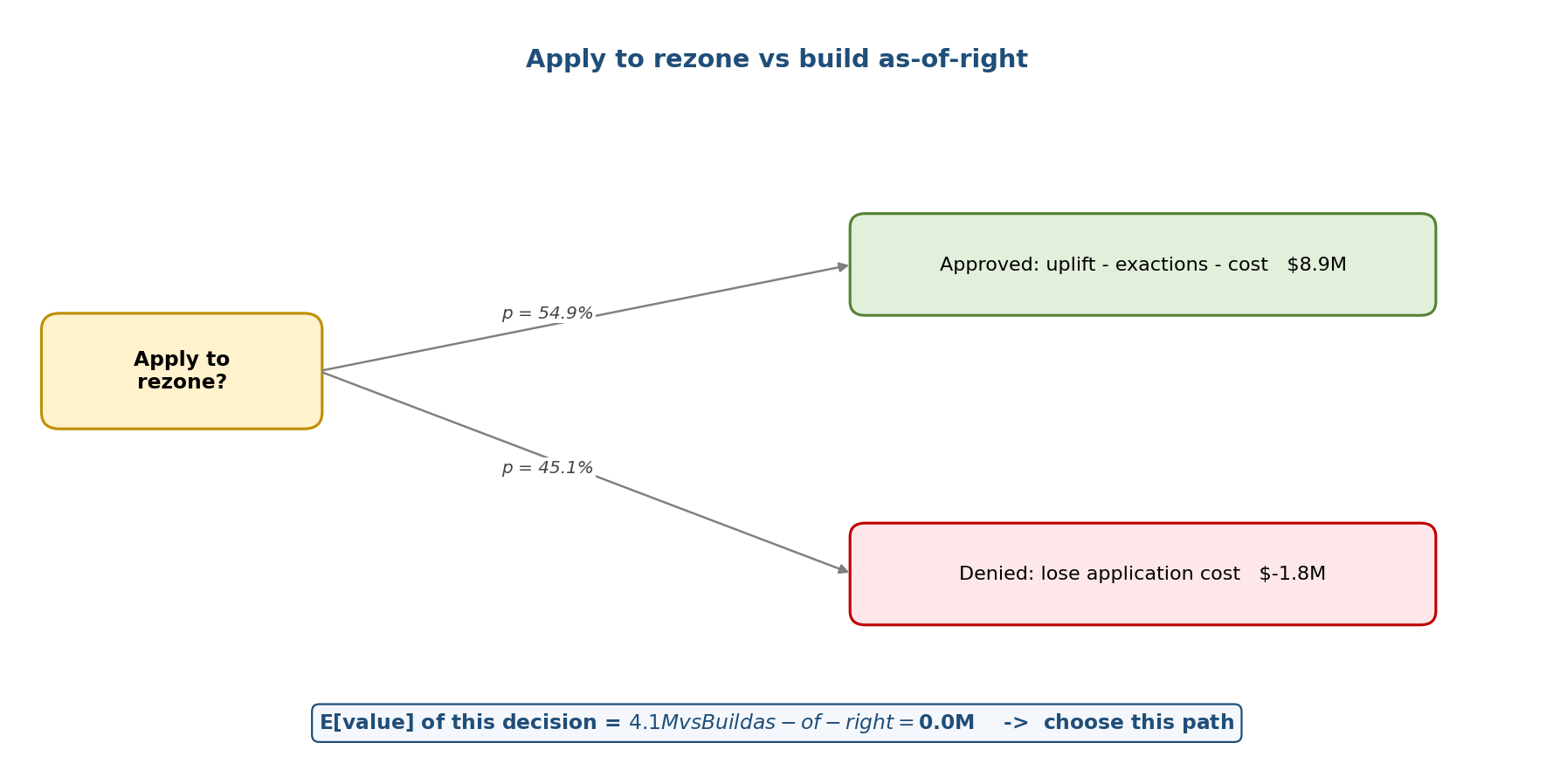
Framed as the decision it is: apply (55% approved, worth +$8.9M on the approved branch; 45% denied, worth −$1.8M) gives an expected value of +$4.1M, versus $0 for building as-of-right. On expected value, apply wins. But the tree also makes the risk explicit — the +$8.9M approved branch is an average over a wide LogNormal, and nearly half of all outcomes land below zero. The tree is the right tool precisely because this is a go/no-go decision against a certain alternative, and it shows both that the EV favours applying and that the developer must be able to absorb the downside branch.
The approval odds the developer must reach
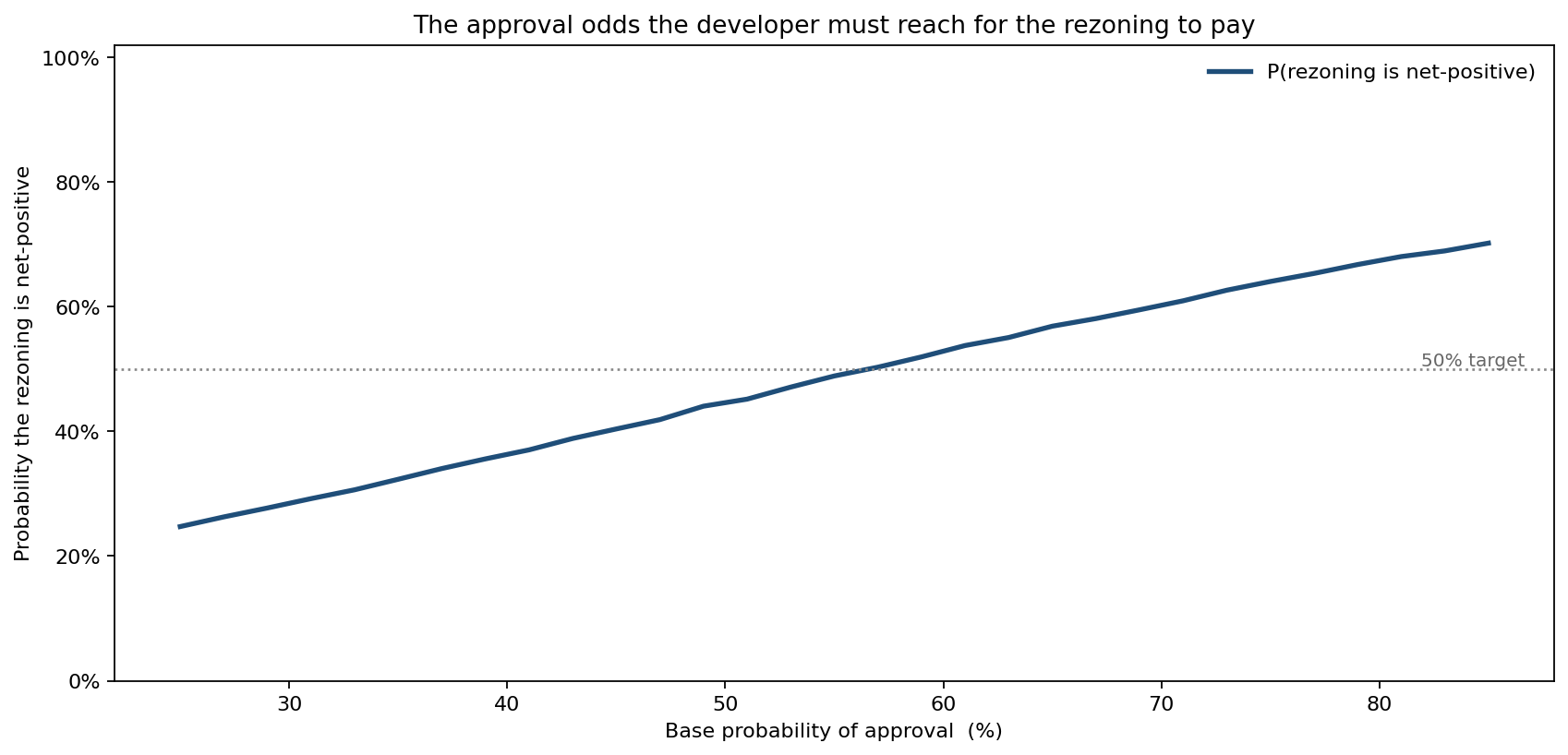
Approval probability is partly a lever — lobbying, community benefit, pre-application negotiation, and offering affordable housing all move it. Sweeping the base approval probability shows what that lever buys: at a 30% base probability the rezoning is net-positive only 29% of the time; at 50% it reaches 45%; at 55% (the base case) 49%; at 65% it climbs to 57% and at 75% to 64%. The expected value stays positive across the whole range — even a long-shot application is a positive-EV bet given the upside — but the probability of an actual win crosses the 50% coin-flip line near a 57% base approval probability. Every point of approval probability the developer can secure before filing is worth real money on both EV and win-rate.
What drives the net value of the bet
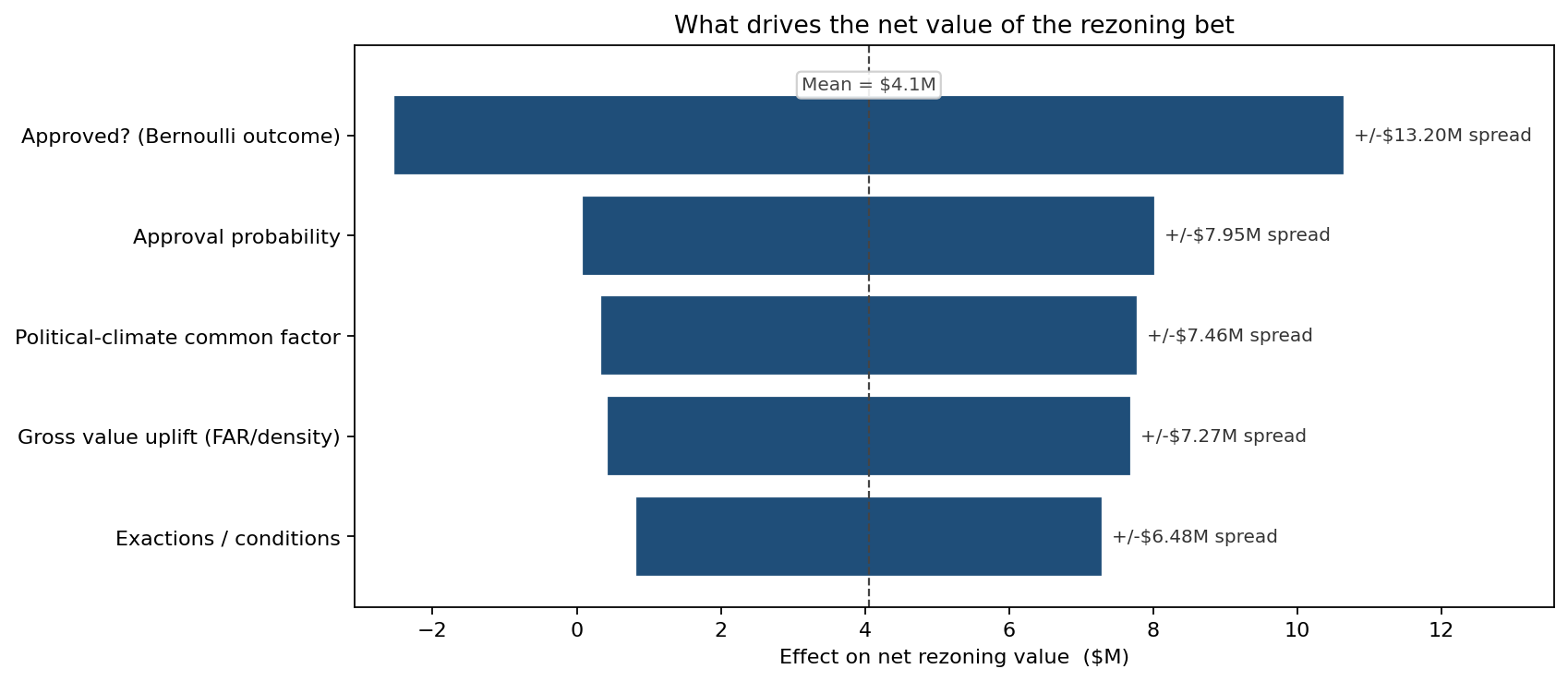
The approved/denied outcome itself is the largest driver (±$6.60M) — the bet lives or dies on the vote. The approval probability (±$3.98M) and the political-climate common factor (±$3.73M) come next, ahead of the gross uplift (±$3.64M) and the exactions (±$3.24M). The ranking is the strategic message: refining the uplift estimate to the nearest dollar matters far less than moving the approval odds. Due-diligence effort and pre-application spend should go into the political process, not into a fourth decimal place on the density-bonus pro forma.
What the model changed
- The decision was reframed from "what is the uplift worth" to "is the bet positive-EV and can we absorb the downside." The answer — yes (+$4.1M EV) but only a 49% chance of paying off — set realistic expectations with the investment committee.
- Pre-application spend was redirected from refining the uplift estimate to raising the approval probability (community benefits, affordable-housing offer, council engagement) — the driver the tornado identified.
- A −$1.8M downside was budgeted as a known cost of the option, not treated as a remote risk, since it occurs in 51% of futures.
- The affordable-housing concession was repriced as approval insurance — accepting heavier exactions in exchange for lifting the approval probability past the 57% point where the bet becomes more-likely-than-not to win.
ModelRisk Functionality Used
- Beta prior on the approval probability combined with a Bernoulli approval outcome — separating the uncertainty in the odds from the binary realisation of the vote.
- Political-climate common factor linking approval probability, exaction size and uplift — imposing the negative approval–exaction correlation (−0.52, verified) that a point estimate and an independent-variable model both miss.
- LogNormal value uplift capturing the right-skewed payoff of a density grant, which is what makes the bet positive-EV despite a sub-50% median.
- Decision-tree expected-value comparison of apply-to-rezone versus build-as-of-right, with a probability-weighted footer.
- Approval-probability sweep quantifying how much the win-rate and EV move with the one lever the developer can influence, and a rank-correlation tornado pointing effort at the approval process rather than the uplift estimate.
A zoning change is a bet, not a forecast: an uncertain prize behind an uncertain vote, with conditions attached and a non-refundable stake. Monte Carlo simulation in ModelRisk is what lets a developer see that the bet is positive-EV and a coin flip at the same time — and act on both facts instead of only the comfortable one.