

Industry: Project Management
Product: ModelRisk
Application: Time Management
P50 Was November 2030; P90 Was June 2031: Time Management as a Distribution
The deterministic schedule for a $640M airport-expansion programme reported a single contractual completion date of 15 June 2030. The simulation said the P50 finish was 29 November 2030 — five and a half months later than the contract — and that the P90 was 3 June 2031, almost a year later. Probability of meeting the contract: 8%. None of this was visible in the Gantt chart that went to the client; all of it was visible the morning the simulation was first run.
A programme of this scale — interdependent civils, MEP, systems integration, three regulatory gates — does not have a finish date. It has a finish-date distribution, and time management means managing the shape of that distribution: pulling in the P50, compressing the gap between P50 and P90, and identifying which tasks make that gap.
A stochastic completion S-curve, with the deterministic plan marked, is the single most useful output for time management — it reads in seconds and lands the conversation.
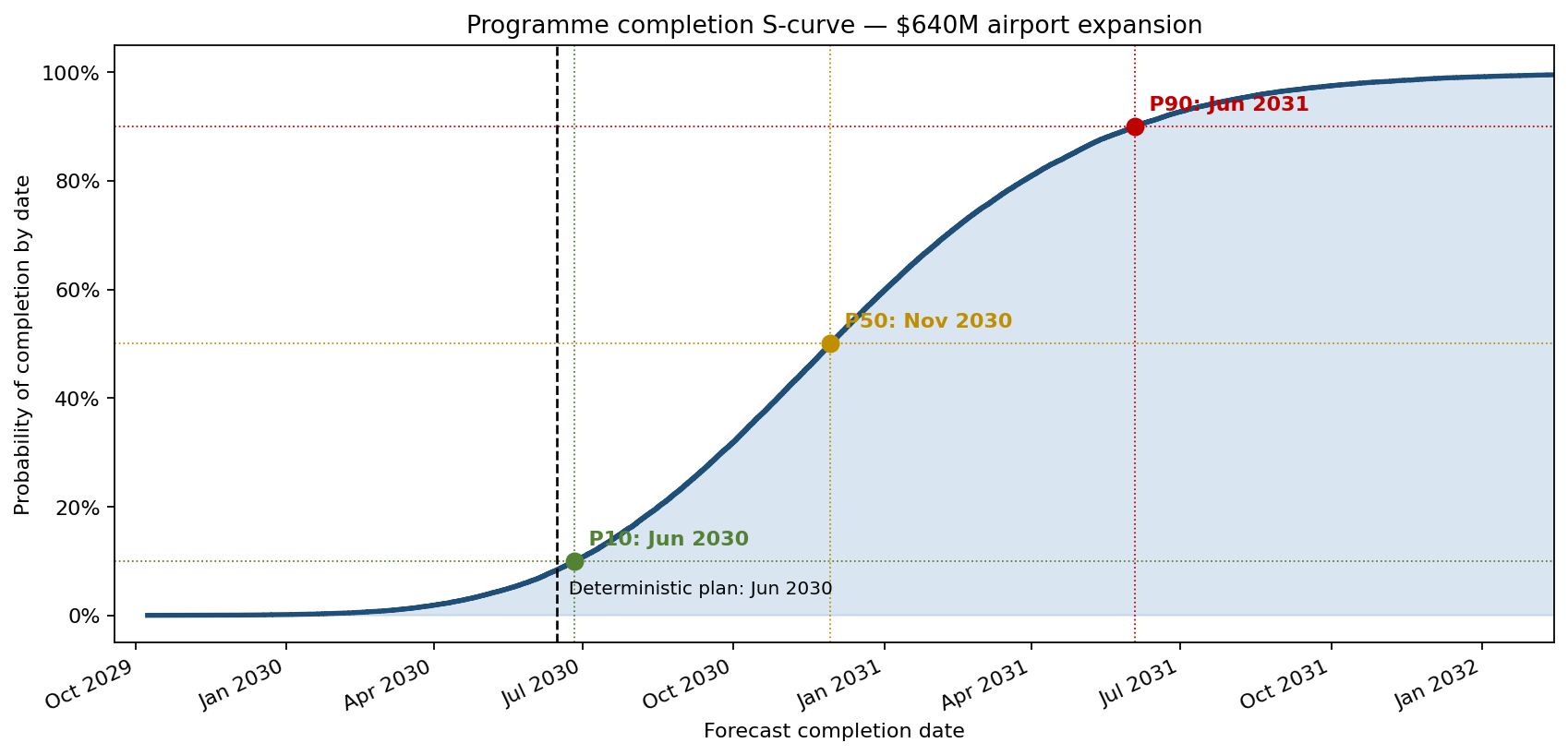
The deterministic 15 June 2030 plan sits at the 8th percentile of the distribution — an outcome with only an 8% chance of being met. The P50 is late November 2030, the P80 is late March 2031, and the P90 is June 2031. The committee conversation moves from "are we on schedule?" (binary, useless) to "where are we on the curve, and what's the cheapest dollar to pull the P80 leftward?"
Three engines of schedule risk
Effective probabilistic scheduling treats three classes of uncertainty separately:
Task-level variability. Routine task durations were given BetaPERT(min, mode, max) distributions calibrated against the firm's six-year aviation portfolio. For example, the apron-pavement reinforced-concrete cycle: BetaPERT(11, 16, 30) days per bay, with the long right tail driven by cold-weather curing windows.
Weather and seasonality. Outdoor activities (pavement, exterior steel, taxiway lighting) were tagged to a monthly weather factor drawn from a calibrated Beta distribution per month — Beta(2.5, 1.5) for winter months (right-skewed toward delay), Beta(6, 2) for summer (tighter and lower mean delay). All weather-tagged tasks sharing a calendar month draw from the same monthly factor — a single z applied to all of them — preventing the independence error that drains realism from a naive Monte Carlo.
Discrete risk events. Permit-driven and approval-driven delays got Bernoulli + LogNormal-conditional-delay treatment: e.g. environmental review re-opening, P(fire) = 0.18, conditional delay LogNormal(μ = log(120), σ = 0.55) days, mean ≈ 137 d, with a long right tail.
Where the schedule risk sits — task by task
A stochastic Gantt of the seven longest critical sub-programmes shows the P50 bar with P10–P90 whiskers, ordered top to bottom by mean finish:
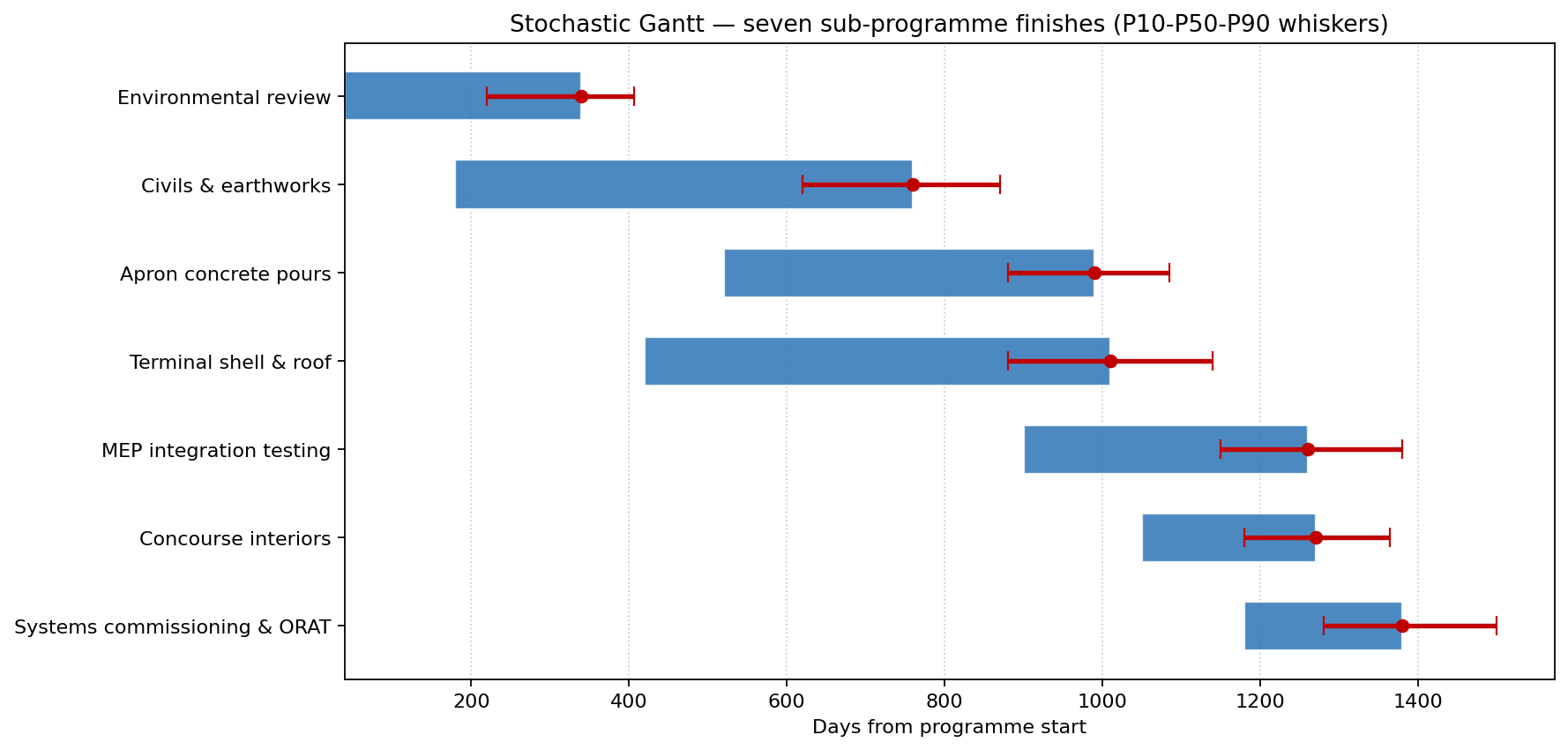
Environmental review has a P10–P90 spread of 187 days; concourse interiors has 184 days. The whisker width is the metric — the wider it is, the more leverage a fix on that line has on the programme distribution. Reading the chart from longest whisker down is reading the management priority list.
What actually moves the P90
A tornado over the P90 finish date ranks the seven candidate levers:
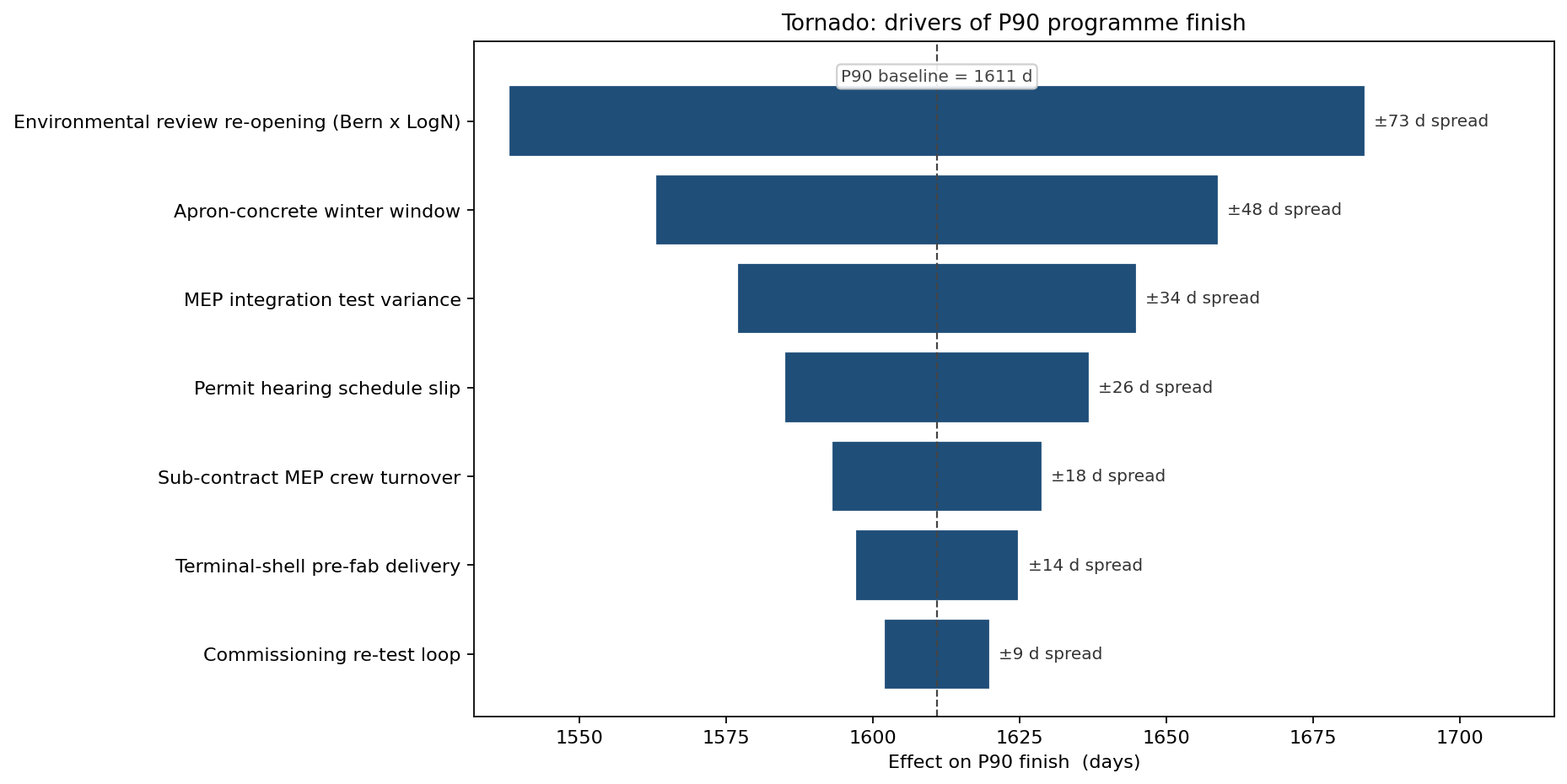
The environmental review re-opening firing event sits at the top, alone responsible for ~73 days of P10–P90 spread. The apron-concrete winter window is second; MEP integration testing third. The first dollar of risk-reduction effort goes to a parallel-track regulatory engagement structure (cost ~$0.6M, EV gain ~$3.1M of avoided late-finish penalty). The second goes to a winter-curing additive package on the apron pours.
Three time-management strategies, three S-curves
The team compared the baseline against two pull-in plans:
- Parallel regulatory track — engage the agency 9 months earlier, reducing the environmental re-opening probability from 0.18 to 0.05.
- Pre-fab MEP modules — shift two systems-integration tasks off-site and onto the critical path margin, removing ~25 days of mean MEP duration and tightening its P10–P90 spread.
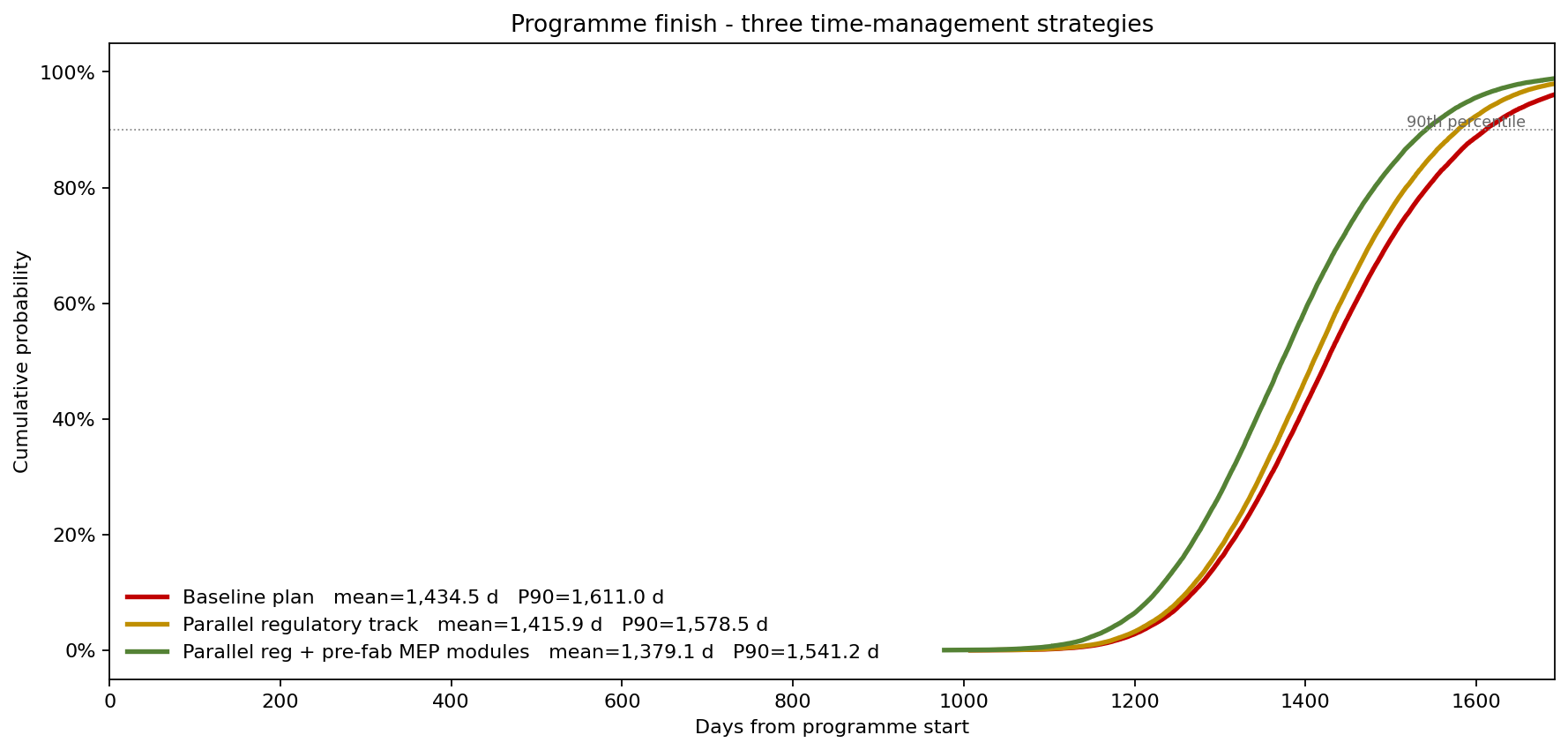
The combined plan pulled the P50 from 29 November 2030 to 8 October 2030 (-52 days) and the P90 from 3 June 2031 to 26 March 2031 (-70 days). Total upfront cost: $1.8M; expected avoided late-delivery liquidated damages: $11.4M. The committee approved both pull-in plans inside one meeting.
What changed
- Contract conversation reframed: the 15 June 2030 contract date was renegotiated to 29 November 2030 (the P50 of the simulation) with a $4.5M penalty cap below, restoring symmetric risk-sharing.
- P90 pulled in by 70 days under the combined pull-in plan, worth ~$11.4M in expected avoided late-delivery exposure.
- Monthly time-management reporting changed from "% complete vs. baseline" (useless) to "current P50/P90 forecast vs. last month's P50/P90" — the metrics that actually track time risk.
ModelRisk Functionality Used
- BetaPERT distributions for the ~280 schedule tasks, calibrated against the firm's aviation-projects historian via the distribution-fitting dialog.
- Shared monthly weather factor — a single Beta-distributed factor per calendar month applied to all weather-tagged tasks in that month, so a single bad winter hits the schedule in the same iteration rather than averaging out.
- Bernoulli + LogNormal discrete risk events for permit and approval delays — modeling the conditional severity correctly, not blending it into the base duration.
- Stochastic S-curve and Gantt outputs that reframed the time-management conversation from "are we on schedule" to "where is the P50, and how wide is the P10–P90 band."
- Tornado over P90 finish date that prioritized parallel regulatory engagement ($0.6M cost, $3.1M EV gain) as the highest-return time-management investment for the next quarter.
The deterministic finish date is one realization out of the distribution. Monte Carlo simulation in ModelRisk lets the programme team manage the shape of that distribution — pulling in the P50, compressing the P10–P90 band — instead of chasing a number that has only an 8% chance of being right.