

Industry: Engineering
Product: ModelRisk
Application: Thermal analysis
When a 422 MPa Nominal Hides a 21% First-Cycle Crack Rate: Thermal-Stress Risk Across a Duty Cycle
A constrained brazed joint takes a temperature swing of about 165 degC every duty cycle. The textbook constrained-expansion formula — stress equals constraint factor times modulus times expansion coefficient times the swing — gave a nominal peak stress of 422 MPa against a 480 MPa yield allowable, a 58 MPa cushion that looked adequate. It was not. When the joint's duty cycle, material lot and assembly fit-up were each carried as distributions through ModelRisk, the peak-stress distribution put 21% of cycles past yield on the very first cycle, and the Coffin-Manson fatigue calculation showed 29% of joints cracking before their 4,000-cycle design life.
This is not the steady operating temperature of a component — it is the mechanical stress a temperature swing induces when the part cannot freely expand. Different physics, different failure mode, different risk.
Why one stress number was the wrong deliverable
When expansion is constrained, a thermal cycle drives a stress:
sigma_thermal = C x E x CTE x delta_T
with C the constraint factor (0 = free to expand, 1 = fully built-in), E the elastic modulus, CTE the coefficient of thermal expansion, and delta_T the temperature swing. Each term has real spread. The duty cycle is not always 165 degC — normal operation clusters there, but hot soaks reach 220 degC. The alloy's CTE and modulus scatter from heat to heat, and within one heat they move together. The constraint factor depends on assembly fit-up, which varies build to build. Multiply four uncertain terms and the product is far wider than any of them — and crucially, the deterministic 422 MPa sits below the mean of the resulting distribution because the right-skewed swing pulls the average up.
Modelling the cycle, the material and the fit-up
- Temperature swing delta_T — Triangular(110, 165, 220) degC. Normal operation near the 165 degC mode, with a tail of hot soaks to 220.
- Coefficient of thermal expansion CTE — Normal, 17.5e-6 /degC, built from a shared per-lot bias (sd 0.7e-6 across 30 alloy heats) plus small within-lot scatter. Parts from one heat share their expansion behaviour; that correlation is what keeps the stress tail realistic instead of collapsing toward a thin Normal.
- Elastic modulus E — Normal, 195 GPa, with its own per-lot offset tied to the same heat structure.
- Constraint factor C — Triangular(0.55, 0.75, 0.92), capturing fit-up and clamp variation across assemblies.
Because the CTE and modulus biases are per-heat rather than per-part, summing many independent draws does not wash the spread out — the common-mode lot factor is what preserves the tail that produces first-cycle cracks.
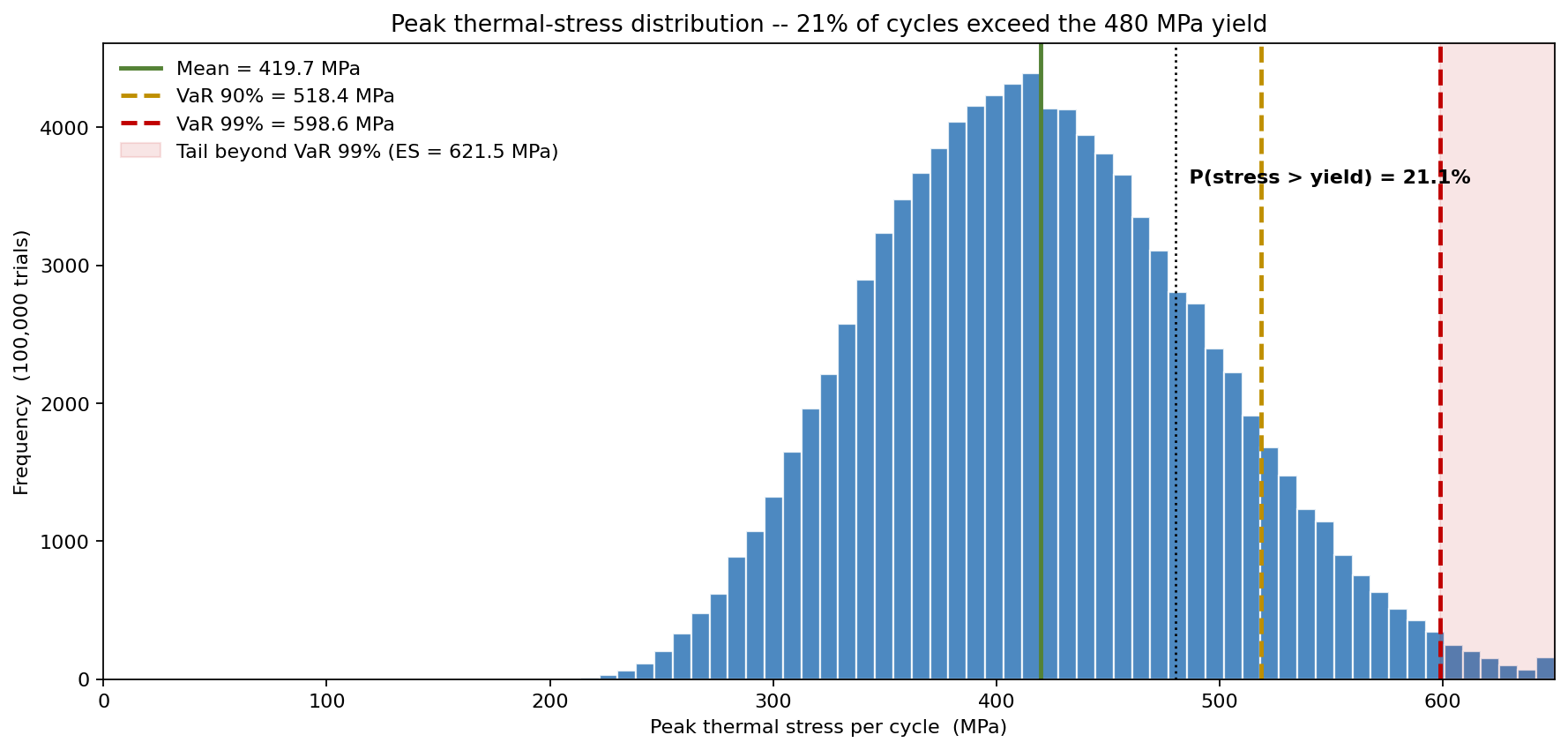
The peak-stress distribution is the headline. Mean peak stress is 420 MPa, P50 is 416 MPa, P90 is 518 MPa and P99 is 599 MPa. Against the 480 MPa yield, 21.1% of cycles exceed it — the first-cycle crack risk the 422 MPa nominal could not show. P90 alone, at 518 MPa, is already 38 MPa over yield.
What drives the peak stress
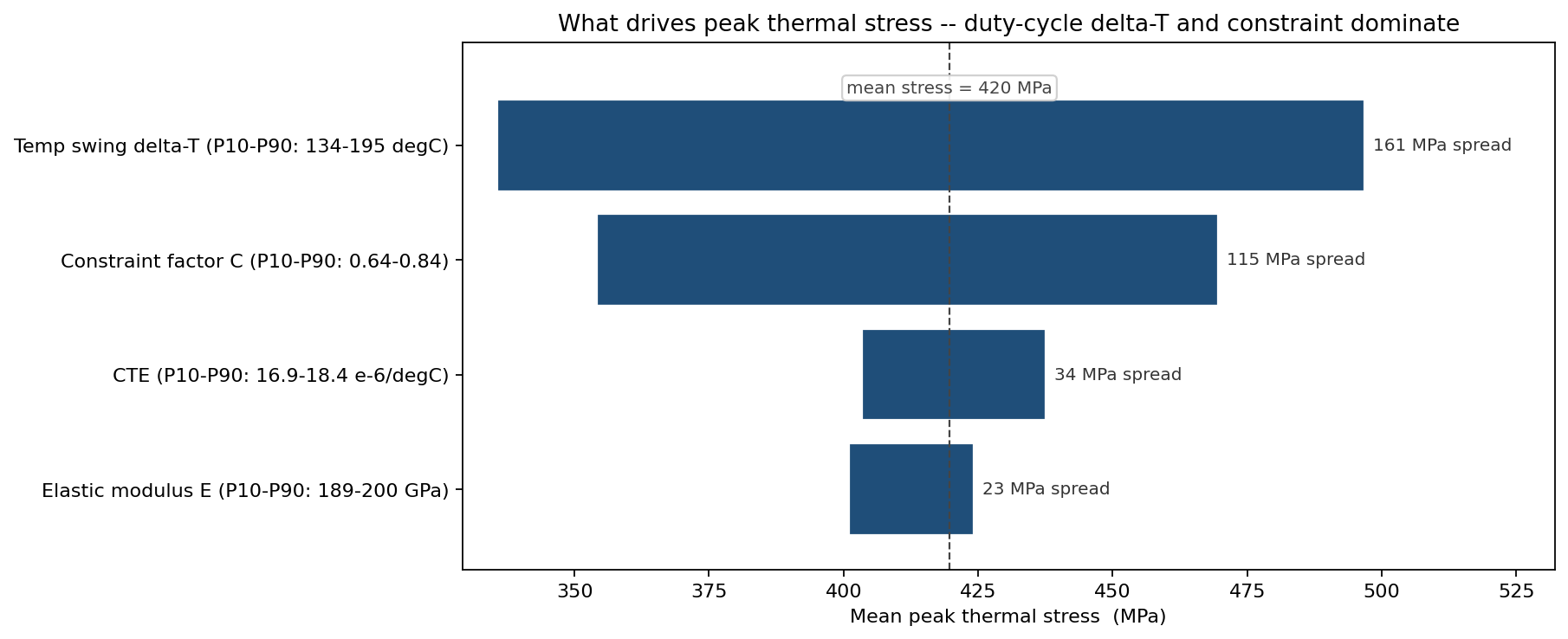
Holding each input at its P10 then P90 while the others stay stochastic ranks the four drivers against the 420 MPa baseline:
| Input | Stress at P10 input | Stress at P90 input | Spread |
|---|---|---|---|
| Temperature swing delta_T | 336 MPa | 497 MPa | 161 MPa |
| Constraint factor C | 354 MPa | 470 MPa | 115 MPa |
| CTE | 403 MPa | 437 MPa | 34 MPa |
| Elastic modulus E | 401 MPa | 424 MPa | 23 MPa |
The duty-cycle swing dominates (161 MPa of spread), with the constraint factor a strong second (115 MPa). The material properties — the things engineers instinctively reach to control — barely move the answer by comparison. The risk is in how hard the part is cycled and how tightly it is held, not in the alloy.
Capping the duty cycle buys down both failure modes
Since the temperature swing is the top driver, the obvious lever is a duty-cycle limit. Sweeping the worst-case swing the cycle is allowed to reach maps both failure modes at once.
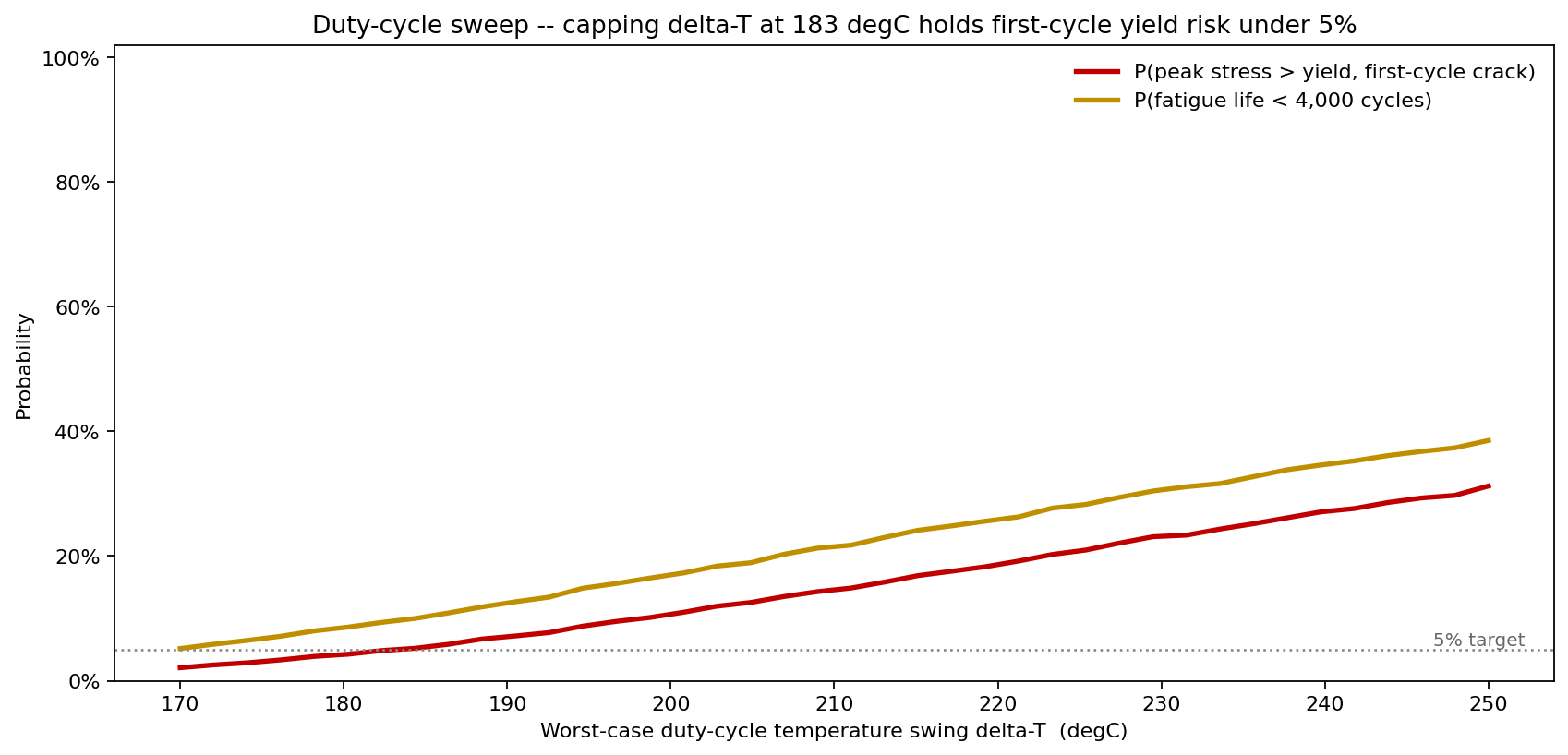
- At a 180 degC cap, P(first-cycle yield) is 4.2% and P(fatigue life < 4,000 cycles) is 8.5%.
- At 210 degC, those rise to 14.6% and 21.5%.
- At 240 degC, 27.1% and 34.7%.
Holding first-cycle yield risk under 5% requires capping the swing at 183 degC — which became the operating constraint written into the duty-cycle specification.
The fatigue tail behind the warranty exposure
Peak stress only tells the first-cycle story. Feeding the per-cycle plastic strain range into a Coffin-Manson life model turns the same simulation into a cycles-to-failure distribution against the 4,000-cycle design life.
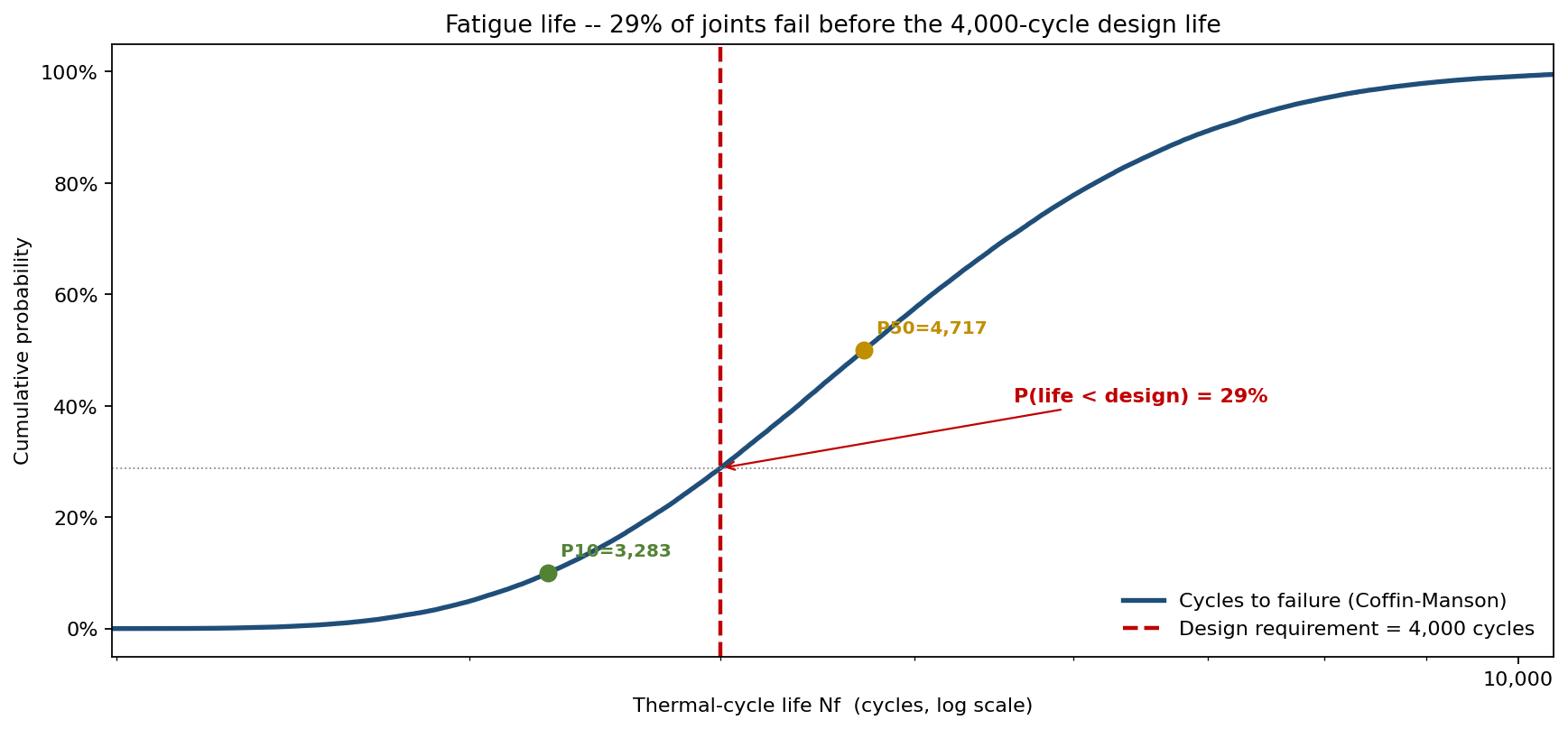
P10 life is 3,283 cycles, P50 is 4,717 cycles — and 28.8% of joints fail before the 4,000-cycle design requirement. The median joint clears the design life with room to spare, which is exactly why a deterministic median-based check passed; but nearly a third of the population sits in the lower tail that the median hides. That 29% shortfall, not the comfortable median, is the warranty exposure.
What the model changed
- A 183 degC duty-cycle cap was written into the operating specification, the value the sweep showed holds first-cycle yield risk under 5%.
- Constraint factor targeted in redesign after the tornado ranked fit-up (115 MPa of spread) second only to the swing; a compliant standoff was added to lower C rather than upgrading the alloy.
- Material qualification refocused on lot consistency rather than mean CTE, once the model showed per-heat common-mode bias — not within-lot scatter — preserved the dangerous stress tail.
- A 29% fatigue-shortfall figure replaced the passing median check in the life-assessment report, reframing the joint as a warranty risk that needed the duty-cycle cap to close.
ModelRisk Functionality Used
- Constrained-expansion stress simulation propagating four uncertain inputs through sigma = C x E x CTE x delta_T into a peak-stress distribution (mean 420 MPa, P99 599 MPa) that exposed a 21% first-cycle yield rate the 422 MPa nominal masked.
- Per-heat common-mode CTE and modulus bias preventing central-limit collapse of the stress tail, so the first-cycle crack probability reflects correlated lot behaviour.
- Coffin-Manson fatigue layer converting per-cycle plastic strain into a cycles-to-failure distribution, surfacing the 28.8% shortfall against the 4,000-cycle design life behind a passing median.
- Duty-cycle temperature sweep locating the 183 degC swing cap that holds first-cycle yield risk at 5%, sizing the operating constraint directly.
- Paired yield-and-fatigue sweep evaluating both failure modes on the same simulated population, so the duty-cycle limit was tuned against both at once.
A deterministic thermal-stress check asks "is the peak stress below yield?" and answers yes at 422 MPa; Monte Carlo asks "what fraction of cycles crack on the first pass, and what fraction of joints survive their design life?" — and here those answers were 21% and 71%, neither visible in the single number.