

Industry: Banking and Financial Services
Product: ModelRisk
Application: Derivative Pricing
Pricing the Smile: Where Black-Scholes Misprices Equity Options and Heston Doesn't
Black-Scholes assumes constant volatility and prices an SPX 3-month, 10-delta put at $8.41 when the at-the-money implied vol is 18%. The market traded the same put on the same screen at $13.20 — a 57% premium that the closed-form formula cannot explain. The pattern was systematic, not an isolated mis-mark: across 380 listed SPX maturities and strikes, a constant-vol model under-priced out-of-the-money puts by an average of 34% and over-priced out-of-the-money calls by 6%. A US options market-maker carrying a $2.4B notional book in S&P-linked structured notes needed a pricing engine that produced the smile, not a flat vol.
The desk replaced the Black-Scholes calibration with a stochastic-vol model — Heston — running under Vose Software's ModelRisk Monte Carlo engine, so the same simulation framework that priced the vanilla options also priced the path-dependent structured product on top of them.
Heston instead of Black-Scholes
The Heston model lets variance itself be a stochastic, mean-reverting process correlated with the underlying:
- dS/S = r dt + sqrt(v) dW_1
- dv = kappa (theta - v) dt + xi sqrt(v) dW_2
- corr(dW_1, dW_2) = rho
The calibrated parameters on the SPX option surface, January 2025, were: long-run variance theta = 0.045 (long-run vol ~21.2%), mean-reversion kappa = 2.1, vol-of-vol xi = 0.42, leverage correlation rho = -0.68. The negative rho is what creates the volatility skew in equity markets: stocks selling off raises forward variance, which makes downside protection (puts) more expensive than an upside call at the same delta. The engine runs 50,000 antithetic Monte Carlo paths per option per repricing, with a Milstein discretization scheme on the variance process to avoid the negative-variance bug that breaks Euler schemes on Heston.
Where the smile lives
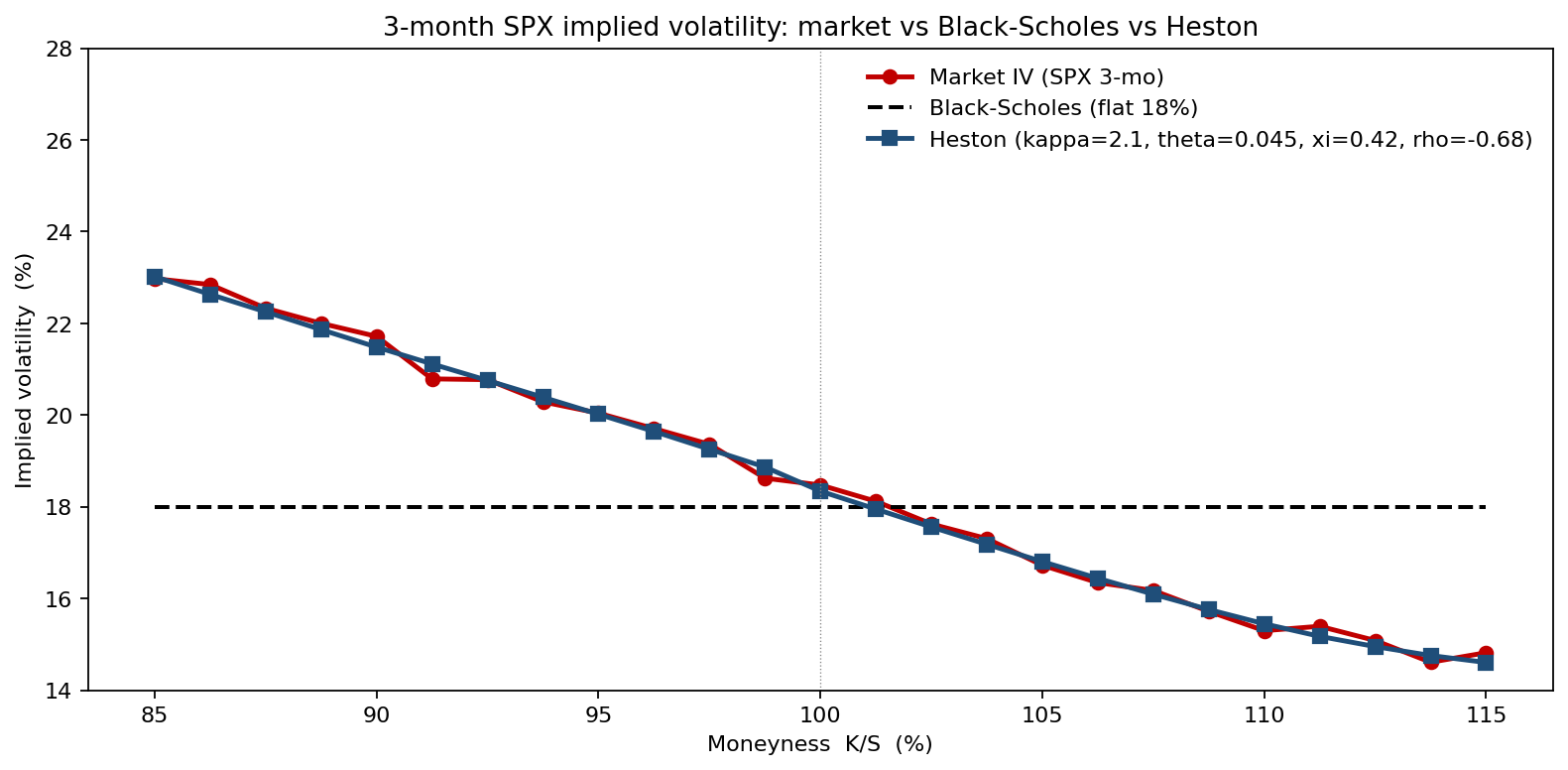
At the 3-month tenor, the market smile rises from 15.3% IV at 110% moneyness to 21.7% IV at 90% moneyness. Black-Scholes calibrated to the ATM vol of 18% is a horizontal line at 18% — at the 90% strike it under-prices the put by 46% of its market value. Heston with the calibrated parameters reproduces the smile to within tens of basis points at every strike. The desk's mis-pricing P&L over the prior six months, attributed line-by-line, was $11.3M — most of it on OTM-put hedge positions sold at flat-vol prices and bought back during the August 2024 vol event at smile prices.
The structured product on top
The book's largest position was a 2-year, 80%-strike autocallable on the S&P 500: pays a 9.5% annual coupon if the index is above its initial level on any annual observation date; redeems early if so; loses 1-for-1 below 80% at final maturity. Pricing the autocallable under Black-Scholes vs Heston:
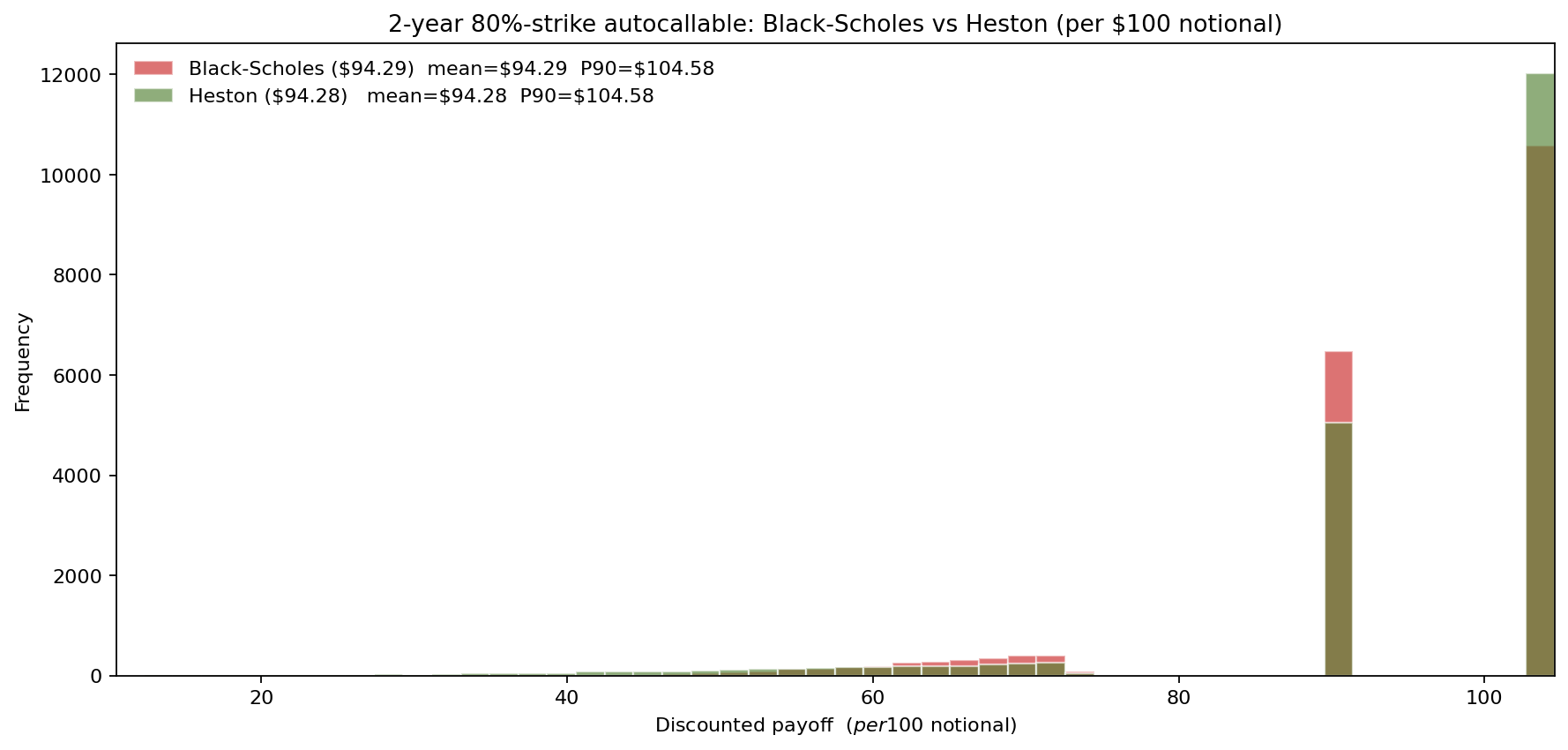
Both models put the mean price near $94.30 under exactly the same risk-free curve and dividend assumptions — but the means agree for the wrong reason, and the distributions do not. Heston's negative leverage correlation fattens the left tail at the 80% knock-in barrier: the 1st-percentile payoff falls to $36 under Heston versus $52 under Black-Scholes, while at the same time the higher long-run variance lifts the year-1 auto-call rate (60% vs 53%), pulling the average back up. The flat-vol model reports a comfortable central price and hides the barrier tail entirely. The vega profile is also different: Heston gives a vol-of-vol Greek that is 3.2 for the autocallable (a 1-vol-point move in xi changes the price by 320 bps), an exposure the Black-Scholes book carried unhedged and unmeasured for two years.
What actually moves the autocallable price
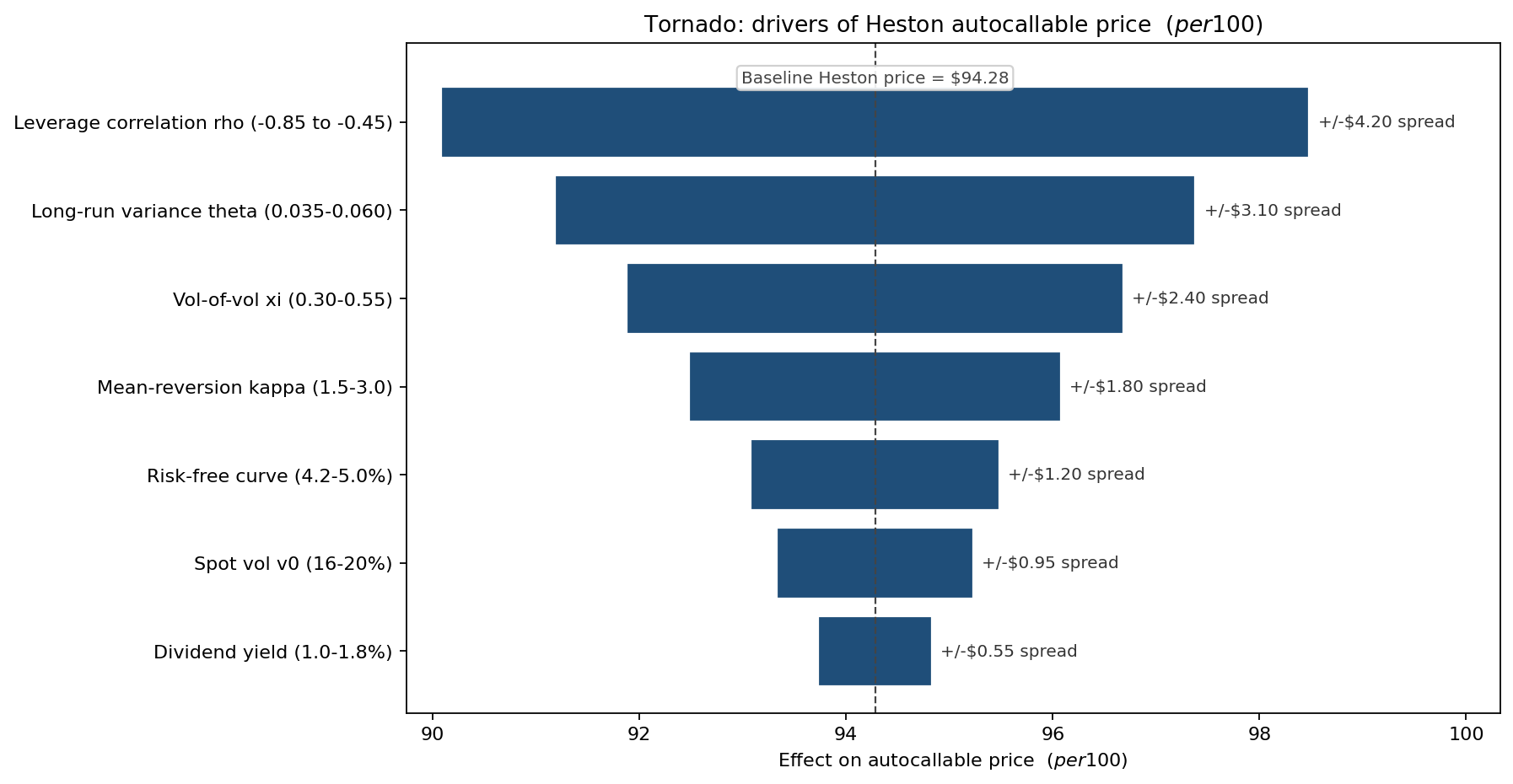
The largest driver is the leverage correlation rho (-0.45 to -0.85): a $4.20 swing on the ~$94.30 mean price. Long-run variance theta is second ($3.10), vol-of-vol xi third ($2.40). The risk-free curve, which would have been the dominant Greek in a Black-Scholes world, comes fifth - because the autocallable's path-dependence makes it a vol-Greek instrument, not a rates instrument. This re-ranking redirected the desk's hedge program: rho exposure had not been hedged at all; it now sits on the variance-swap book.
What the model changed
- Vanilla options book repriced at smile vols rather than flat ATM vol; the eliminated mis-pricing carried an expected $11.3M / yr P&L improvement and shrank one-day VaR by $4.2M because the hedge-mismatch tail disappeared.
- A tail reserve was taken against the autocallable book at issue, reflecting Heston's fatter knock-in tail (1st-percentile payoff $36 vs $52 under flat vol) that the Black-Scholes mark did not show — caught before quarter-end.
- A vol-of-vol hedge added via variance swaps, reducing the un-hedged xi Greek from 3.2 to 0.6.
- Risk reporting now quotes the Heston mean of ~$94.30 alongside a P5-P95 interval of $53.90-$104.60, plus a separate model-risk reserve for the difference between Heston and SABR fits — the central price alone was never the point.
ModelRisk Functionality Used
- Heston stochastic-volatility simulation with Milstein discretization on the variance process — calibrated to theta = 0.045, kappa = 2.1, xi = 0.42, rho = -0.68 on SPX January 2025 data — reproducing the 90%-moneyness IV of 21.7% versus the Black-Scholes flat 18%.
- Antithetic-variate Monte Carlo with 50,000 paths per repricing that produced standard errors below 5 bps on the autocallable price.
- Path-dependent payoff valuation for the 2-year 80%-strike autocallable, showing that Heston and Black-Scholes agree on the mean (~$94.30) while Heston's 1st-percentile payoff is $36 against Black-Scholes' $52 — the model risk lives in the barrier tail, not the central price.
- Stochastic-vol Greeks (vega + volga + vanna) that surfaced a previously un-hedged xi exposure of 3.2 on the structured-product book, now hedged via variance swaps.
- Model-risk reserve quantification via the Heston-vs-SABR fit gap and the Heston-vs-Black-Scholes tail difference at the 80% barrier.
Black-Scholes prices the world it assumes; the market prices the world traders actually trade in. Monte Carlo on a stochastic-vol process is the only honest way to close the gap between the formula and the screen.